

YOU ARE FREE!
Sermontelling John 20:1-18 (NL 439)
BIBLETELLING
Below is the Narrative Lectionary passage for the coming week. It is followed by Bruce’s notes on the text which aim at a general understanding of the text and some notes on the structures and techniques used by the Biblical storytellers.
Early in the morning of the first day of the week, while it was still dark, Mary Magdalene1 came to the tomb and saw that the stone had been taken away from the tomb.2 She ran to Simon Peter and the other disciple, the one whom Jesus loved, and said, “They have taken the Lord from the tomb, and we don’t know where they’ve put him.”3 Peter and the other disciple left to go to the tomb. They were running together, but the other disciple ran faster than Peter and was the first to arrive at the tomb. Bending down to take a look, he saw the linen cloths lying there, but he didn’t go in.4 Following him, Simon Peter entered the tomb and saw the linen cloths lying there. He also saw the face cloth that had been on Jesus’ head. It wasn’t with the other clothes but was folded up in its own place.5 Then the other disciple, the one who arrived at the tomb first, also went inside. He saw and believed.6 They didn’t yet understand the scripture that Jesus must rise from the dead. Then the disciples returned to the place where they were staying.7
Mary stood outside near the tomb, crying. As she cried, she bent down to look into the tomb. She saw two angels dressed in white, seated where the body of Jesus had been, one at the head and one at the foot. The angels asked her, “Woman, why are you crying?”8
She replied, “They have taken away my Lord, and I don’t know where they’ve put him.”9 As soon as she had said this, she turned around and saw Jesus standing there, but she didn’t know it was Jesus.
Jesus said to her, “Woman, why are you crying? Who are you looking for?”10
Thinking he was the gardener, she replied, “Sir, if you have carried him away, tell me where you have put him and I will get him.”11
Jesus said to her, “Mary.”
She turned and said to him in Aramaic, “Rabboni” (which means Teacher).12
Jesus said to her, “Don’t hold on to me, for I haven’t yet gone up to my Father. Go to my brothers and sisters and tell them, ‘I’m going up to my Father and your Father, to my God and your God.’”13
Mary Magdalene left and announced to the disciples, “I’ve seen the Lord.” 14Then she told them what he said to her.
John 20:1-18 [CEB]
THREE STORIES
The following three stories pair well with the Narrative Lectionary passage for the coming week. They are followed by Danny’s sermontelling footnotes which explore the stories’ theological connection to the passage as well as insights into craft and performance. Our advice is to read the story first before digging into the footnotes.
THE TOWER
Magdalene’s birth name was ‘Mary.’ But all of the other disciples called her ‘Magdalene’15 so she went with it. At first, she didn’t like the nickname but it had grown on her. It made her feel like part of the group.
And that was important because Magdalene had a rough road to becoming a disciple. Ever since she was a teenager, she struggled with crippling mental illness. Doctors today might have been able to treat her bipolar disorder with medication but in the first century they didn’t see a chemical problem; they saw a spiritual one. When you experienced deep depression, psychosis, and severe mania, no one knew what to make of you. You didn’t know what to make of yourself. You felt like something truly dark and evil had taken over your life. You weren’t in control of your thoughts, your words, or your actions. So who was? Most would answer: an evil spirit. If you heard voices telling you to harm yourself and others, showing you terrible things you didn’t want to see, you didn’t go to a doctor; you went to an exorcist.16
Magdalene was so out of herself the first time she met Jesus, she barely remembers it. He was just a shadowy stranger distorted by her mind into something sinister. She vaguely remembers throwing things at him and shouting profanities. What she remembers clearly is the way his voice seemed to cut through the howling black anger that was swirling all around her and touch, for a brief moment the scared little girl trapped inside or her. With a single word. Her name: “Mary.” She was grounded, if only momentarily.
It took seven visits from Jesus for Magdalene to finally be free.17 Seven visits of patient listening. Seven visits in which his voice pierced through a little more and a little longer each time: “Mary!”
“Mary!”
“Mary!”
“Mary, Mary, Mary”
Until she was finally ready to come out. So when she became a disciple, she was welcomed with open arms. They knew how hard her journey had been. There was just one problem. Peter was the first to say what the others were thinking.
“Jesus, we have too many Marys as it is. I don’t think we can handle one more. We have Mary from Bethany. Your Mom. James’ Mom. Clopas’ wife. It won’t do. Before this Mary can join, she needs a new name.”
Jesus loved giving his disciples nicknames. He was good at it too. He always managed to pick one that summed up both the person’s outward appearance and their personality. So, steady dependable Simon (who was built like a brick) was named ‘Peter’18 which meant ‘the Rock.’ He named Thomas, ‘Didymus,’ which meant ‘twin.’ Yes, Thomas was an identical twin but he also had twin natures that pushed and pulled at him. Sometimes he was brash and impetuous, other times, cautious and calculating. You get the idea, he named James and John, blessed with their dad’s booming voices (and quick temper), ‘Boangeres.’ The ‘sons of thunder.’ Young, smooth faced, John, who Jesus treated like a little brother, was ‘Agapitos.’19 Beloved. Jesus was great at nicknames.
So, presented with the possibility of a 5th Mary in the group, Jesus knew he needed a good one that would stick. He studied her for a moment. The most striking thing about her, the thing that everyone seemed to notice, was that she was tall. Not just for a woman. She was taller than most of the guys.
Jesus smiled, “You are now called Magdalene.” It was the feminine form of the Aramaic word for ‘tower.’20 Mary wasn’t a huge fan of it. She had always been self conscious about her height. But that didn’t matter. Now all the disciples were chanting: “Magdalene… Magdalene… Magdalene…”
This new nickname wasn’t going anywhere. It was one of the costs of discipleship. After a while, Magdalene got so used to it that she didn’t lift her head with the other women whenever someone said, “Mary.”
If she was honest, Magdalene didn’t get the nickname. Yes, she was tall. But her similarity with towers ended there. What was the deeper meaning? She wasn’t some spiritual fortress who protected everyone. She wasn’t some beacon that everyone looked up to. She felt like the most vulnerable and the least exemplary of all the disciples. Magdalene was a liability.
People in ancient times knew what people today know: demons have a habit of coming back.21 The spiritual struggle was a lifelong struggle. There were times when Magdalene could feel the darkness creeping back in. She would hear faint whispers of those old voices. She would have a flash of a dark vision. Feelings of hatred and self loathing would try to get a foothold. And in those moments, she would go to Jesus.
“Rabbouni,” she would say. This was Jesus’ nickname. It was Aramaic for ‘Teacher.’ But it was more of a term of endearment than the standard ‘Rabbi.’
“Rabbouni,” Magdalene would say in desperation. She wouldn’t need to say anything else. He could always hear it in her voice. In those moments, he always called her ‘Mary.’ Something about hearing him say her name always grounded her. Then he would listen patiently and pray with her. Then she would be ready to face the world again. The world that called her ‘Magdalene.’ The Tower.
What Magdalene wouldn’t give to hear his voice this morning. These last two days, she could feel the darkness creeping back in and no one could help her. Because Jesus was gone. Two days earlier, she had watched him breathe his last from the cross beam after several hours of struggle. She had seen them take the body down just before the Sabbath. She had seen it taken to a nearby garden and placed in a tomb. She’d seen the soldiers seal the tomb with a large stone.
All day that Sabbath, Magdalene rested with the other disciples. They were too busy with their own shock, grief, and depression to see that she was spiraling. Magdalene was hearing the old voices. Feeling the dreadful feelings. Seeing terrifying sights. Not full bore. She wasn’t out of herself but she felt like in a few days she would be. The anxiety of knowing she was powerless against what was coming was worse than what Magdalene was currently experiencing. She needed him. She needed Jesus to say her name and to tell her not to be afraid. But he never would again.
It was that need that drew Magdalene to the tomb before dawn on the first day of the week. Maybe if she could just be near him— Even his lifeless body —she might feel okay, just for a little bit. But when she got to the tomb, the stone had been moved. When she looked inside, the body was missing.
Magdalene screamed. For a moment she feared she was seeing things again. It was the most terrible thing she could think of: some stranger just stealing Jesus’ body. It transported her back to all those times she swore strangers were sneaking into her home and moving things. Was this just her paranoia? No it was real. Jesus was gone.
Magdalene ran back to the house. When she got there Peter and John were outside. They could tell she was distraught. “Magdalene, what’s wrong?”
She shook and sobbed. She knew she looked and sounded crazy but she couldn’t help it. “They took him!”
“Took who!”
“Jesus! They took him. I don’t know where. They moved him!”
Magdalene crumpled into a ball on the ground and wept. “Why would they do that!?!?”
To their credit, if Peter and John doubted her story, they didn’t show any sign of it. They ran off toward the tomb.
Now the sun was coming up. Magdalene caught her breath and managed to keep herself from shaking. She breathed slowly in and out. She prayed the prayer Jesus had taught her.
     Father
     Let your name be sanctified.
     Let your Kingdom come.
     Give us our bread for today.
     Forgive us as we have forgiven others.
     Lead us not into trials.
     Amen.
When Magdalene was finished, she stood up. Calmer now, she followed after Peter and John. By the time she arrived at the tomb, they were leaving.
“Someone has definitely moved the body,” Peter said.
Magdalene was relieved that she wasn’t seeing things.
“Let’s go tell the others,” John said.
“You all go ahead,” said Magdalene. “I’m going to stay for a little while.”
When Peter and John were out of sight, Magdalene let herself weep again. She looked back into the tomb. She wasn’t really sure what she was expecting to see. Maybe she wanted to confirm one more time that she hadn’t made the whole thing up. This time when she looked inside the tomb, she saw two young men dressed in white. Not wool. Pure white. Bright as a flash of lightning. Their eyes burned with intensity. Their skin almost seemed to glow. Great. Now she was seeing things.
They spoke in one voice. A voice that seemed to come from beyond them.
“Woman, why are you weeping?”
“Someone has taken him,” Magdalene said. “Someone has taken him and I don’t know where they put him...”
She turned and saw a man behind her. She was so distraught she couldn’t think or see straight. Who was it? Was it the gardener?
The man asked the same question. “Woman, why are you weeping? Who are you looking for?”
Were they mocking her? Were they all in on it? Who were these people? Magdalene couldn’t look the man in the face.Her eyes darted around as she said,22 “Sir, If you’ve put him somewhere, just tell me where and I’ll put him back myself. JUST TELL ME! I won’t tell anyone, I promise, just tell me…”
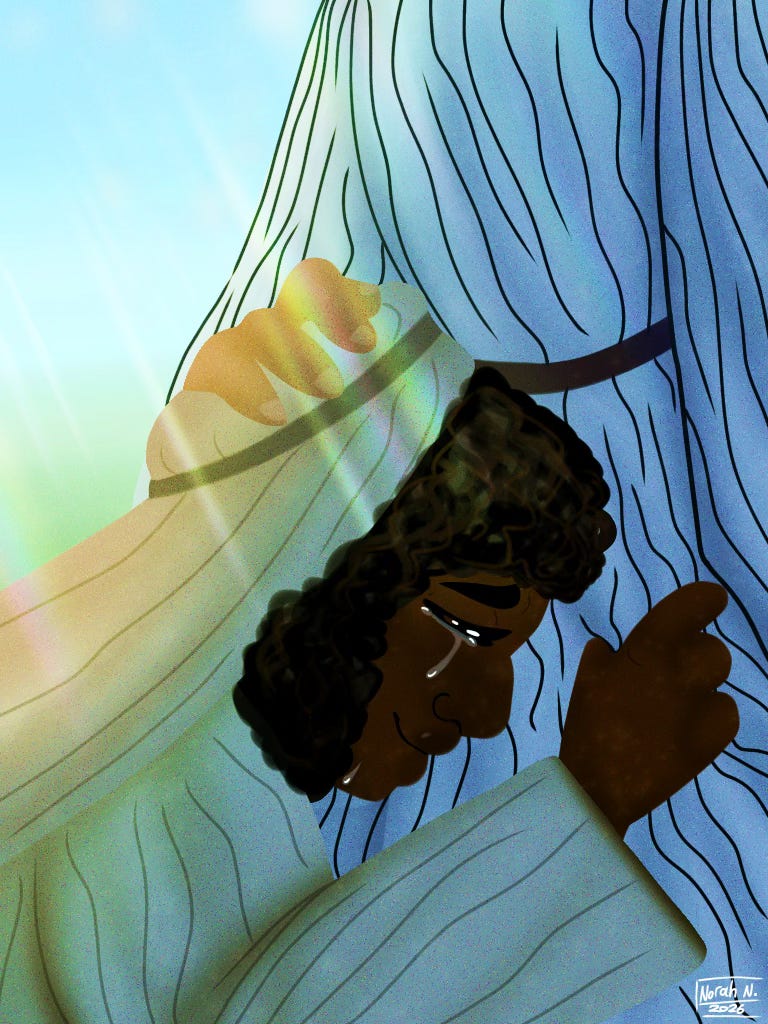
“Mary.”
The voice cut through all the darkness in her heart as it had so many times. It grounded her.
“Mary.”
She looked up at his smiling face. “Rabouni!”
She was about to hug him but he stopped her. “Don’t touch me. I’ve not yet ascended to my father.”
Magdalene had no idea what that meant but she was just happy to be hearing Jesus talk cryptic nonsense again.
“Mary,” Jesus said, “I have an important message for you. You must go to the others and tell them, ‘I am ascending to my father and your father, to my God and your God!’”
“They’ll know what that means?”
Jesus just laughed. God, she’d missed that laugh. Magdalene did as she was told. She ran out of the garden, down the dusty road to where the disciples were staying. As she ran that morning, she was the only person in the whole world who knew the good news. She was the whole church!23
When she arrived, the disciples were sitting around discussing what might have happened to Jesus’ body. Magdalene burst into the room, looking for the words to say. There was joy written all over her face.
“What?” asked Peter.
They looked up at Magdalene. She straightened up. In that moment, she towered above them like a beacon of light. She spoke with unshakable confidence.
“I have seen the Lord!”
~ My own retelling of John 20:1-18
THE LENTEN GOOSE
Little is known about Saint Felicitatis,24 who is not to be confused with Felicitas of Rome who lived fifty years earlier. Felicitatis was the servant or slave to Perpetua and both women were martyred in Carthage of North Africa in 203 CE under emperor Septimus Serverus. We know too little about them, so scholars debate the details and the dates. Both women were recent converts to Christianity in this apparently regional persecution in North Africa. They refused to recant their beliefs, as so many Christians in North Africa did. In fact, Perpetua was baptized in prison. Perpetua’s father, a pagan, pleaded with her to recant her Christian faith, but she refused. We hear nothing about Felicitatis or Felicity in this process. Both died heroically, steadfastly refusing to recant. They are heroes and appropriately regarded as saints in the Christian tradition.25
It was the spring semester of my first year in seminary, 1971. I lived on the second floor of a dormitory on campus with a roommate whom I knew since high school. In the two rooms next to ours were four other students who had been together in the pre-ministerial training system since high school. Most of the other guys on that floor at least knew each other from our junior and senior years in college. So we were all pretty close friends.
At the end of the hall there was a seminarian who was new to the educational system; none of us knew him before. He was short and dumpy, a very friendly and smiling guy, who cheerfully said hello to everyone he passed. He was Martin. Martin always wore black clerical clothes and a collar, which most of us did not, and he seemed a little eccentric. Not eccentric in a bad way, but in a nice way. He also wore a little black beret all the time. Someone nicknamed him Friar Tuck.
One day Martin came down the hall from his room at the far end of the hall away from the stairwell, and he had a goose on a leash. The goose walked very obediently in front of Martin almost as if he or she were trained.
“Martin, why the goose?” one of us asked.
“This is Saint Felicitatis, and she is my Lenten goose.” Well, indeed, Ash Wednesday had just passed that week, so it was Lent. “When Lent is over, I intend to cook and eat her for Easter.”
There was a silent and uncomfortable pause.26 “Really,” I said.
“Yes, indeed. She will observe the vigil of Lent, and then I will cook and eat her. She is an Easter goose.” There was more silence among us. Then Martin said, “Come along Saint Felicitatis, we must go to class now.” He moved down the hall as we stood there in silence.
After he went down the stairwell, we said among ourselves, “Well, we always knew he was eccentric.”
One of said, “He’s such a cheery fellow. That’s a little ghoulish.”
I observed, “Saint Felicitatis was a famous martyr in Carthage around 200 CE. When I heard the name, I thought immediately that this isn’t going to end well.”
Martin went down the sidewalk to the classroom building, a long walk, since our dorm was the farthest residence away from the main campus. People along the way would stop and ask him, “Why do you have a goose on a leash?”
His response was the same. “This is Saint Felicitatis, my Lenten goose. I intend to cook and eat her for Easter Sunday dinner.”27 The usual response was silence.
Saint Felicitatis went to class and stayed by Martin’s side on the leash. Of course, professors would ask the question, “What is that goose doing in the classroom?”
Martin would respond, “This is Saint Felicitatis, and she is my Lenten goose. At the end of the Lenten vigil, I will cook her and eat her for Easter dinner.” I don’t believe that any professor had a follow up question to that. Professors generally did not push questions with students who appeared to be somewhat eccentric.
Throughout the rest of the Lenten season Martin and Felicitatis became a regular sight on campus. No one asked the questions anymore. We just observed him with quiet bemusement. He was quite the sight—in his black clerical clothing with a white goose on a leash in front of him.
Well, Easter came and passed. We were in the dorm when Martin came strolling down the hall that week, sans Saint Felicitatis.
“Martin, where’s the goose? Where is Saint Felicitatis? Did you cook her and eat her?” one of us asked.
“I took Saint Felicitatis to the big lake in Forest Park, from where you can see the art museum. I showed her the lake, I pointed out the ducks in the lake along with a couple of swans, and I pointed out to her what a beautiful blue sky was overhead on that Easter Sunday. Then I took off her leash and told her to fly away. ‘You are free, Saint Felicitatis! You are free! You are no longer under the sentence of death! It is Easter! Jesus is risen, and you are free!’ Felicitatis then waddled down to the water and swam away. She didn’t fly, but waddling off was good enough. That was her resurrection.” Martin then walked down the dormitory hallway in his usual cheery, bouncy manner.28
We stood there silently. “Well, he sure fooled us,” one of us said.
“The goose, too,” said someone else.
“He’s a genius.”
“Well, he’s something.”
“I think there’s a sermon in there somewhere.”
~ From THE PERSIAN SHEPHERD BOY AND OTHER TALES by Karl Gnuse
CHRIST IS RISEN
Christ is risen this bright morning,
Stone is rolled and Angel sings.
Grave is conquered without warning,
Death has lost its bitter sting.
Why do you look here for the living?
Gates have been opened, all are freed.
Join the earth in loud thanksgiving:
Christ our Lord is risen indeed!

Christ is risen, women sharing,
Telling all the world their news.
People quit your deep despairing,
Hope is here for you who choose.
Follow the way of Him who saved you,
Ending the curse on Adam's seed.
Cast the sin which once enslaved you,
Christ our Lord is risen indeed!

Christ is risen, stranger walking,
On this long and dusty road.
All this time while we were talking,
Were our eyes still somehow closed?
Seeing the bread, we now awaken,
Hearing the Word that meets our need.
Never shall we be forsaken,
Christ our Lord is risen indeed!

Christ is risen, O believer,
Now is not the time for doubt.
Death was but a breaking fever,
Lazarus has been called out.
Feel now the wound of living Jesus,
Touching his scars will you not heed,
To the only Truth that frees us:
Christ our Lord is risen indeed!

Christ is risen and is showing,
Grace and mercy by the shore.
You who sinned while cocks were crowing,
Come be cleansed forever more.
Open your hearts which once were hardened,
Show him your love by lambs you feed.
Give to them these words of pardon:
Christ our Lord is risen indeed!

Christ is risen, O disciple,
Go make more in all the earth.
Let the Spirit not be stifled,
For it brings a second birth.
Lo He is with us through the ages,
No single book can tell His deeds.
All our lives are brand new pages.
Christ our Lord is risen indeed!

Christ is risen and is seated,
At the right of holy God.
Lamb upon His altar greeted,
By the Lion's crown and rod.
Come all you Christians and adore Him,
Marching with cross and righteous creed.
Bow with moon and stars before Him.
Christ our Lord is risen indeed!

Christ is risen and returning,
Like a shepherd for His sheep.
Ended is the orphans yearning,
Never more shall widows weep.
Coming with justice to the nations,
Judging their license, war, and greed.
Look! He makes new all creation.
Christ our Lord is risen indeed!
~ Original Poem
From the Archives: GERONIMO THE GRUB
“You really are the most inquisitive creature I have ever come across. Since you’re so eager to find out what lies above, I’ll give you a ride upon my back and you can see for yourself, the frog offered, exasperated by all the questions. Geronimo was delighted. He climbed onto the frog’s back and up they went!
But the moment they reached the surface-crash! He reeled back into the pond, gasping for breath. He clung to the stem of a water plant, trembling with shock and disappointment, until the frog joined him. “There is nothing beyond this pond but death,’ he wept. “Why did you tell me all those stories about beautiful colours and bright light?”
SERMONTELLING NOTES:
The Gospel of John includes five (possibly even six?) resurrection stories, more than any of the other gospels. Today’s reading encompasses two of these. The two stories are intertwined in structure, beginning with Mary Magdalene’s discovery of the stone rolled away, shifting to the story of Peter and the beloved disciple entering the empty tomb, and then returning to the Mary Magdalene story as she seeks and encounters the missing Jesus.
At some point in church history, Mary Magdalene comes to be seen as a reformed prostitute. In fact, the scriptures never make this claim. Instead, she is identified as one from whom seven demons had been driven out (Mark 16:9, Luke 8:2). She is often listed among Jesus’ disciples and is uniformly named as one of the women who first discovered the empty tomb and reported what they had seen to the men of the group.
At this point in the story, Mary is not said to have actually looked into the tomb to see that it was empty. This, of course, does not mean that she did not do so. It is possible, though, that she assumes the missing body from the fact that the grave has clearly been disturbed.
As noted above Mary Magdalene is given credit in all four gospels for carrying news of the empty tomb to the other disciples. The church has often called her the apostle to the apostles.
The author is quite insistent that the “beloved disciple” was the first to arrive at Jesus’ empty tomb. He is also the first to see the abandoned grave clothes.
The mystery of the folded napkin is a lively one. That the fact that John mentions facecloth being carefully laid aside not once, but twice, seems to be a clue that the storyteller saw something particularly significant in the fact. Some suggest that a master, when leaving the table during dinner, would fold his napkin as a sign to the servants that his place should not be cleared because he intended to return. Serious historians, though, report that there is no evidence that such a custom existed in Jesus’ time.
The Greek word used here is soudarion, and is actually not really a Greek word at all. It is borrowed from Latin, where it means literally “sweat cloth.” While the word sometimes is used to describe the cloth used to bind the jaw as part of the burial clothing, it more commonly refer to the cloth used to wipe sweat from a workers brow. “Handkerchief” or even “bandana” might be the best English translation. This may be of interest in that Jesus next appears in Mary Magdalene’s story mistaken for a gardener.
In any case, the left behind graveclothes, especially any piece that is carefully folded and set aside, seem to act as evidence against any sort of hasty grave robbery.
The storyteller again reminds us that the beloved disciple was the first to arrive at the tomb. We are, perhaps, also to understand that this disciple was first to believe in the resurrection of Jesus, though the following line will affirm that he has no idea as yet exactly what this fact might mean.
By itself, this resurrection story featuring Peter and John is reminiscent of the “first ending” of the gospel of Mark. We are left with an empty tomb and no real idea what it means. Fortunately for us as readers, this is not the end of the story. Jesus will appear to his disciples over the coming days to help them (and us) understand the meaning of his death and resurrection.
It is useful, though, to recognize how incredibly disorienting the initial discovery of the empty tomb must have been to Jesus’ followers. Those of us with a bent toward storytelling might take a crack using our imaginations to guess what sorts of thoughts the disciples may have been having in this liminal moment.
The storyteller returns our attention to Mary Magdalene, outside the tomb, weeping. When she bends to peer into the tomb, she witnesses something quite different than what Peter and the beloved disciple had seen. She sees two angels, one at each end of the burial shelf, who ask her why she is weeping.
The appearance of heavenly beings in pairs should evoke a number of images for listeners familiar with the Biblical narrative. God placed a pair of cherubim at the gates of Eden when Adam and Eve were cast out after the fall. The cherubim were there to guard the path that led back to the Tree of Life.
Likewise a pair of cherubim were carved to be placed above the lid of the Ark of the Covenant. Other pairs of Cherubim were woven into the veil of the Holy of Holies” and engraved on the Temple doors. This symbol was no coincidence. The Tabernacle/Temple is absolutely loaded with imagery intended to evoke the Garden of Eden. Author Michael Morales sees the symbolism of worship in the Temple as an enactment of the worshipers reentering God’s presence in a symbolic Eden.
Mary repeats the words which she earlier spoke to Peter and the beloved disciple. She believes that someone has taken Jesus’ body from the tomb. This is not necessarily a sinister accusation. The tomb in which Jesus’ body had been placed was never intended as permanent. Tombs of this sort were temporary places for the body while the flesh decomposed. The bones would then be collected and placed in an ossuary, a small coffin just large enough to house the now disconnected bones. The tomb was a borrowed one, and the owners of the tomb might have simply decided to take the body elsewhere.
They would not, however, have left behind the graveclothes. Mary, as far as we know, though, never looked inside the tomb and saw the graveclothes. For her, the problem to be solved is simple and practical. Just tell me where the body is.
To “turn around and see” is a feature of Biblical visionary literature. It seems intended to communicate the disconcerting nature of a profound visionary experience. Note that the device is repeated in verse 20:16. This visionary language is not to imply that what Mary is seeing is not actually happening, but her experience must have had a very similar feel to it. She is sufficiently off-balance to not recognize Jesus.
Jesus repeats the question first asked by the angels “Why are you crying?” before adding the question “Who are you looking for?”
Mary assumes she is speaking to a gardener. The storyteller has told us (using the word twice!) that Jesus’ tomb was in a garden. This explains why Mary assumed the man she was speaking to might be a gardener.
Only John’s gospel tells us that the scene of the Resurrection of Jesus was a garden. This, coupled with the pair of angels which Mary witnessed within the tomb seems to suggest that John wants us to see the Resurrection as a symbolic return to Eden.
She finally recognizes Jesus when he names her by name. A theme in John’s gospel is that God must grant people the power to see Jesus for who he really is.
This is obviously a puzzling passage. Why does Jesus forbid Mary from touching him when ten verses later (20:27) he actually commands Thomas to do so?
The answer Jesus offers is that he has not yet ascended to the Father. To grasp what is going on here, I think we need to go back to the idea of Jewish Temple worship and possibly reimagine what is going on. Again, I find Michael Morales and his book Who Shall Ascend the Mountain of the Lord extremely helpful.
We often assume that the purpose of a Temple offering was to appease God by the spilling of blood. Sin must be dealt with, and the wages of sin is death. With this as our starting place we consider that the work accomplished by an offering is complete when the animal has been destroyed. Morales argues, though, that the purpose of the offering is to enact the worshiper’s reentry into the Eden state and the presence of God. With this as our starting point, we do not think of the animal as being destroyed, but rather transformed into a state that can enter God’s presence. The smoke of the offering ascending into heaven is what completes the offering.
Jesus spoke often of his ministry as one who came down from heaven and who would return to heaven. We see this thought reflected in John 13:1, for example.
The gospel of John’s theology is heavily laced with Temple theology from beginning to end. Jesus does not view his sacrifice (as the Lamb of God) complete because he has died, or even because he has been resurrected. His sacrifice can only be viewed as complete when he has ascended into God’s presence on behalf of all humanity. This view breathes life into his words to Mary “I am ascending to my Father and your Father, my God and your God.”
Since his sacrifice is currently incomplete, it is ritually important that his body remain untouched by unclean hands
This answer to the question opens us to another riddle, though. If his ascension into heaven is the point, what is he doing walking around in the garden as though he has nowhere else to be? What is he waiting for?
Here I find the parallel with John 20:27 informative. The accounts of Mary Magdalene and Doubting Thomas are brought together by the idea of “touching” Jesus, even though Mary is forbidden and Thomas is encouraged. We may assume that Jesus has (in the meantime) completed his sacrifice by ascending to the Father and has now come back. As we compare these two stories, we discover two stories in which the Resurrected Jesus makes an appearance specifically to comfort and encourage a single disciple called by name. To put it colloquially, Jesus has stopped on his way to heaven to visit and encourage Mary!
Mary Magdalene’s witness is now complete. She is the first to have seen the Resurrected Messiah and report the good news to others.
THE TOWER
Luke 8:2 refers to Mary as “Mary, called Magdalene.” Simon is often referred to as Simon, who is called Peter.” Thomas is referred to as “Thomas called ‘the twin.’” I take this to mean that Magdalene was her nickname that would have set her apart from the other Marys in the group. The name that is rendered in English as ‘Mary’ was very popular among Jews in the first Century. The Aramaic would have actually been ‘Maryam’ (after Moses’ sister, and the prominent Hebrew prophetess, ‘Miriam’).
This retelling seeks to map the experience of mental illness on to Mary’s story. I believe that being honest about the fact that a prescientific understanding of mental illness as being caused by evil spirits pervades the gospel account, does not take away from Jesus’ role as a healer. Just as Jesus used folk remedies of his day (saliva and mud for salves) as a vehicle for his divine power, so he used exorcisms. Prescientific societies kept exorcists and shamans around because their methods seemed to work, however they might scientifically be described today. When looked at through this lens, the Gospels have incredible good news for people who struggle with mental health issues today: people whom society abandoned because he didn’t know what to do with, Jesus sought out and put on the path toward healing.
Luke’s intimation that seven demons had gone out of Mary Magdalene can mean several different things. Being that seven was the number of completion, it could simply mean that at one time she was ‘completely possessed.’ It could mean that she suffered from some sort of multiple personality disorder. It could mean that Jesus had to drive out seven demons all at once. Or it could mean that it took seven different exorcisms for Mary to be restored.
Retelling a Biblical story often forces us to choose from an array of possible interpretations. Sometimes those interpretations may seem equally valid. I chose the latter of the interpretations because it speaks to a truth of the mental health struggle: it is a process with ups and downs. It may take the seventh visit to a trained professional after months of experimentation with different pill combinations, before we even begin to start feeling ourselves again. That’s ok.
It would have been Cephas, but I have gone with Peter for the sake of clarity and recognition. I want the hearer to think, ‘oh yeah! I remember that…’
For more about Agapitos, you can check out a retelling I did about him a few weeks back.
Elizabeth Schrader Polczer sums up the current scholarship on the name Magdala well:
There have been debates about Mary’s nickname throughout history, and nobody is quite sure what it means. Some think she came from a town called “Magdala,” which simply means “tower” (the Greek ending “-ene” refers to a female person).
But there were many towns called Tower in ancient Palestine, and they always had another word included, such as “Tower of the Fishes” and “Tower of the Flock.” Some other people think that “Magdalene” was a nickname given to Mary.
Saint Jerome wrote: “Mary the Magdalene, who received the name tower-ess’ because of her diligence and ardent faith, deserved to see the risen Christ first before the apostles.”
-Elizabeth Schrader Polczer, GOD’S STORIES AS TOLD BY GOD’S CHILDREN
I subscribe to the nickname theory. I think it is likely that the nickname may have been given to her, yes, because of her towering faith, but also because she was quite tall. Like calling Simon, “Rock,” it could operate on multiple levels.
This is famously expressed in Matthew 12:43-45. Jesus seems to be using an analogy that people understand: demons often come back, even worse. Mental health is a lifelong struggle.
You can take this description as a stage direction.
I cribbed these last two sentences from Elizabeth Schrader Polczer’s chapter in GOD’S STORIES AS TOLD BY GOD’S CHILDREN. GSATBGC is a children’s book from The Bible For Normal People and I highly recommend it as a resource for Biblical storytelling. As soon as I read the line in her chapter, DON’T BE AFRAID: “For a few moments that Easter morning, Mary Magdalene was the only person in the world who knew the good news. She was the whole church.” I knew I was stealing it.
THE LENTEN GOOSE
I am always on the lookout for stories that don’t appear in all the sermon illustration books. This is definitely a unique story that comes from a book called THE PERSIAN SHEPHERD BOY AND OTHER TALES by Karl Gnuse. This particular tale is drawn from Gnuse’s own life.
I admire the craft here. Gnuse gives us a short interesting history of a little known saint. Why? We don’t know yet. This information will add depth to the story later. But if he waits until later to provide this explanation, he will interrupt the flow of an already moving story. So he gives us the information up front. It’s also setting us up for a humorous moment when we discover that this quite somber and serious name has been given to a goose.
This line could be read as a stage direction. You could have fun maintaining a hard stare at the hearer, like your trying to compute, and then saying, “Really.”
This is smart. Having Martin repeat this line over and over, fixes in our heads that the Goose’s fate on Easter Sunday is death. It also creates a funny refrain throughout the story.
Upon reflection, it strikes me that Martin was playing the role of a Biblical prophet. He was acting out his sermon like Ezekiel eating dung or Jeremiah walking around in a yoke. Only Martin’s sermon was one not of judgement but of grace. We are all St. Felicitatis. We are under a sentence of death. But because of Easter, we are freed.
CHRIST IS RISEN
I wrote this poem many years ago as a call to worship for Easter morning. Feel free to use this in whole or in part.