

THE GIVER
Sermontelling Philippians 2:1-13 (NL 444)

BIBLETELLING
Below is the Narrative Lectionary passage for the coming week. It is followed by Bruce’s notes on the text which aim at a general understanding of the text and some notes on the structures and techniques used by the Biblical storytellers.
Therefore,1 if there is any encouragement in Christ, any comfort in love, any sharing in the Spirit, any sympathy, complete my joy by thinking the same way, having the same love, being united, and agreeing with each other. Don’t do anything for selfish purposes, but with humility think of others as better than yourselves. Instead of each person watching out for their own good, watch out for what is better for others.2 Adopt the attitude that was in Christ Jesus:3
Though he was in the form of God,
he did not consider being equal with God something to exploit.4
But he emptied himself
by taking the form of a slave
and by becoming like human beings.
When he found himself in the form of a human,
he humbled himself by becoming obedient to the point of death,
even death on a cross.5
Therefore,6 God highly honored him
and gave him a name above all names,7
so that at the name of Jesus everyone
in heaven, on earth, and under the earth might bow
and every tongue confess
that Jesus Christ is Lord, to the glory of God the Father.8Therefore, my loved ones, just as you always obey me, not just when I am present but now even more while I am away, carry out your own salvation with fear and trembling.9 God is the one who enables you both to want and to actually live out his good purposes.
Philippians 2:1-13 [CEB]
THREE STORIES
The following three stories pair well with the Narrative Lectionary passage for the coming week. They are followed by Danny’s sermontelling footnotes which explore the stories’ theological connection to the passage as well as insights into craft and performance. Our advice is to read the story first before digging into the footnotes.
TWO BROTHERS
Once in a small village in Germany,10 during the 15th century, there were two brothers. Both loved to draw and paint and when both were older they wanted to study to become artists.11 The brothers knew their parents wouldn’t be able to afford to send them to art school so they reached an arrangement. The younger brother agreed to work while the older brother went to school. Then, when the older brother graduated an artist, he would work while the younger brother went to school. So it was that Albrecht Dürer12 went to art school for 5 years while his younger brother worked tirelessly in the mines to pay for his education.
When Albrecht returned home from his studies, everyone in the house greeted him warmly and was excited to see what great art he would produce. But he said, “No, I have made a promise. I will work until my brother has gone through school.” Just then, Albrecht noticed his brother crying.
“What’s wrong?” he asked, “Are you not excited to begin your studies?”
Albrecht’s younger brother held up his hands. They were swollen and crooked from years of hard manual labor. “Brother,” he said, “I have worked my fingers to the bone so you could study art under the great masters. So much so that my hands are bent and arthritic. They can no longer hold a paint brush or a pencil without shaking. You will have to make great art for the both us.”
Albrecht Dürer would certainly go on to make great art, but the piece he is perhaps most famous for is a drawing he did of his brother’s hands: swollen and bent, held palm to palm in a posture of worship. He titled it “hands”13 but to the world, they are known as “the praying hands.”14
~ Old Preacher Story
THE GIVING TREE
Once there was a tree....15
and she loved a little boy.
And everyday the boy would come
and he would gather her leaves
and make them into crowns
and play king of the forest.16
He would climb up her trunk
and swing from her branches
and eat apples.17
And they would play hide-and-go-seek.
And when he was tired,
he would sleep in her shade.
And the boy loved the tree....
very much.
And the tree was happy.
But time went by.
And the boy grew older.
And the tree was often alone.
Then one day the boy came to the tree
and the tree said, "Come, Boy, come and
climb up my trunk and swing from my
branches and eat apples and play in my
shade and be happy."
"I am too big to climb and play" said
the boy.
"I want to buy things and have fun.
I want some money?"
"I'm sorry," said the tree, "but I
have no money.
I have only leaves and apples.
Take my apples, Boy, and sell them in
the city. Then you will have money and
you will be happy."
And so the boy climbed up the
tree and gathered her apples
and carried them away.
And the tree was happy.
But the boy stayed away for a long time....
and the tree was sad.
And then one day the boy came back
and the tree shook with joy
and she said, "Come, Boy, climb up my trunk
and swing from my branches and be happy."
"I am too busy to climb trees," said the boy.
"I want a house to keep me warm," he said.
"I want a wife and I want children,
and so I need a house.
Can you give me a house?"
" I have no house," said the tree.
"The forest is my house,
but you may cut off
my branches and build a
house. Then you will be happy."
And so the boy cut off her branches
and carried them away
to build his house.
And the tree was happy.
But the boy stayed away for a long time.
And when he came back,
the tree was so happy
she could hardly speak.
"Come, Boy," she whispered,
"come and play."
"I am too old and sad to play,"
said the boy.
"I want a boat that will
take me far away from here.
Can you give me a boat?"
"Cut down my trunk
and make a boat," said the tree.
"Then you can sail away...
and be happy."
And so the boy cut down her trunk
and made a boat and sailed away.
And the tree was happy
... but not really.
And after a long time
the boy came back again.
"I am sorry, Boy,"
said the tree," but I have nothing
left to give you -
My apples are gone."
"My teeth are too weak
for apples," said the boy.
"My branches are gone,"
said the tree. " You
cannot swing on them - "
"I am too old to swing
on branches," said the boy.
"My trunk is gone, " said the tree.
"You cannot climb - "
"I am too tired to climb" said the boy.
"I am sorry," sighed the tree.
"I wish that I could give you something....
but I have nothing left.
I am just an old stump.18
I am sorry...."
"I don't need very much now," said the boy.
"just a quiet place to sit and rest.
I am very tired."
"Well," said the tree, straightening
herself up as much as she could,
"well, an old stump is good for sitting and resting
Come, Boy, sit down. Sit down and rest."
And the boy did.
And the tree was happy.
~ THE GIVING TREE, by Shel Silverstein
THE BEGGING KING
As I went begging today19 from door to door they cried, “He is coming! He draws near!” And seeing the dust of your gorgeous chariot, I thought, “Who can this be but a king among kings?”
My hopes soared, and I stood waiting for alms to be given and wealth scattered in the dust. Your chariot stopped right before me, you looked down with a smile, and I knew that the luck of my days had come. Until suddenly you held out your palm and said, “What will you give?”20
Begging from a beggar! What a kingly jest – I was confused and dismayed, but I groped in my sack until I brought out one grain of wheat, the tiniest thing I could afford.
I got home that night and emptied my sack on the floor, only to spy a grain of gold gleaming there in the heap. Then how bitterly I wept. If you did this for a tiny grain of wheat, what would you return if I had given you everything?
~ Deepak Chopra
From the Archives: THE KING AND THE MAIDEN
One evening the King was lying alone in his quarters, tossing and turning in his big empty bed. He had been tossing and turning for hours because he had realized, quite to his shock, that he had fallen in love. He hadn’t set out to fall in love but it had happened anyway. For in his kingdom there lived a beautiful maiden whose mere glance had captured his heart. And now the King lay awake unable to think of anything but her beautiful face. Though this maiden was of humble birth, he had in mind to make her his Queen.
Once he had resolved to do so, all that was left was to figure out the manner of his proposal…21
SERMONTELLING NOTES:
“Therefore” is a key transitional word in Paul’s letters. It moves his readers from the world of theological reflection to the world of Christian action. Philippians Chapter 1 spoke of Paul’s joy being fulfilled in the partnership he enjoyed with the Philippians for the sake of the gospel. His prayer for them was that their love would be enhanced by knowledge and discernment. He helps the Philippians to see that even their sufferings can serve to promote the gospel.
The “therefore” at the beginning of chapter two serves to signal a shift to more concrete recommendations about what gospel partnership and discerning love might entail.
Paul again appeals to love, joy, and partnership and argues that these things are brought to completion when Christian communities find themselves living in unity of desire and purpose. This can happen when each person puts the needs of others ahead of their own
Paul calls upon the example of Jesus to demonstrate what this others-centered attitude might look like. The following verses (Philippians 2:1-11) are rendered as poetry. Many scholars believe that Paul is drawing upon the words of an early Christian hymn with which his readers might already be familiar.
The word translated as “form” here is the Greek word morphe. In English, we’re most familiar with this word as the root word of “metamorphosis.” This word describes the change of (for example) a caterpillar to a butterfly. These are the same creature in two different forms.
The word translated “exploit” is better translated “to stubbornly cling to.”
Christ was willing to let go of his equality with God in order to enter into a human mode of existence.
Verses 7 and 8 take a poetic form called “Chiasm.” His “emptying” of himself is placed in parallel with his death. His status as a “slave” is placed in parallel with his obedience. At the center of this arrangement is a two-fold declaration of Christ’s human form in the incarnation
A1: But he emptied himself
B1: by taking the form of a slave
C1: and by becoming like human beings.
C2: When he found himself in the form of a human,
B2: he humbled himself by becoming obedient
A2: to the point of death, even death on a cross.
The song makes its case forwards and backwards:
The God who made humans in his own image now makes himself into the human image. The now human God takes on the humble yoke of obedience to become the Suffering Servant of Isaiah 52:13-53:12, who pours himself out in death.
Another “therefore,” this one perhaps the most thunderous “therefore” in all of scripture. It is because of the suffering servant’s obedience that the rest of the song may be sung
The one who surrendered his God-status and “made himself of no reputation” is now honored by God and given a name above every name.
It is through his radical obedience that Jesus the human servant became the exalted Christ and ruler of all creation.
Paul draws attention to the Philippian’s exemplary obedience to his own teaching, whether or not he is currently looking over their shoulders. He argues that they should also seek to be obedient to God, even in the face of difficult circumstances where some might not question God’s presence. The God who has made this others-centered way known to us through Jesus will also give us strength to live it out in the world.
TWO BROTHERS
For this week’s passage, which is once again replete with themes and images, I have decided to focus on the theme of self-giving love. Jesus empties himself of his divinity and makes himself a servant on behalf of humanity. For Paul, this is not just a christological truth, it is an ecclesiological imperative. We are called to walk in the way of this same self-giving love, having the same mindset. These stories each play with that idea in some way.
I tell this story as it has been handed down to me in ‘the preacher’s oral tradition.’ There is some evidence that it may not have happened in the way that it is often told, though I have not thoroughly investigated this. My own feeling is that when you have a story like this that is true in the deeper sense but maybe not in the factual sense, there are four possible approaches:
Don’t tell it for reasons of integrity. Many preachers simply feel it is wrong to tell a story they know/suspect to be false in the factual sense and no amount of waxing poetic about storytelling license will convince them otherwise. If so, search for another story which can be historically verified and tell it.
Tell it without comment. On the other end of the spectrum, you can just tell the story, as you heard it, without alerting the congregation to the fact that it may not be factual. ‘We’re preachers, not journalists,’ the reasoning goes. ‘Don’t let the facts get in the way of a good story!’
Tell it with comment. I always find it best to add the comment at the beginning of the story rather than undercut its emotional impact at the end. You might say something like: ‘Now some people say this story happened this way and some people say it happened that way. Others say it didn’t happen one way or the other. But this way is the way I heard it and so it’s the way I’m going to tell it…’ This is a lyrical way of alerting your hearers that there’s some ambiguity. There’s also the charming line: ‘The story I’m about to tell is 100% true but it probably didn’t happen.’
Strip the story of its historical claims. There are some cases in which the supposed historicity of a story is not crucial to its point or its impact and it can quite easily be decontextualized (our story is too tied to the piece of art on which it is based for this approach). For instance, if you find out that story about the little boy standing alone in forest all night not knowing his father was watching in the distance with a bow is not based on actual Cherokee tribal practices (it’s not, sorry), reset the story in a fictional context. What if it happened among cavemen? What if it is a tiny cub who is left in the middle of the jungle? What if it happened one time with a viking and his son? If a story is made up, then you can do anything you want to it!
I’ve seen versions of this story that attempt to save the reveal of Albrecht Dürer’s name until the very end. Some versions even call him ‘Albert’ until the big reveal. I get the idea. They’re going for that Paul Harvey ‘and now you know the rest of the story’ moment. But here’s the problem: most people in our congregations are not going to have any idea who Albrecht Dürer is. The real surprise is the revelation of the ‘praying hands.’ Any art history majors in your congregation may still be surprised by that reveal, anyway. There is really no need to dance around his name.
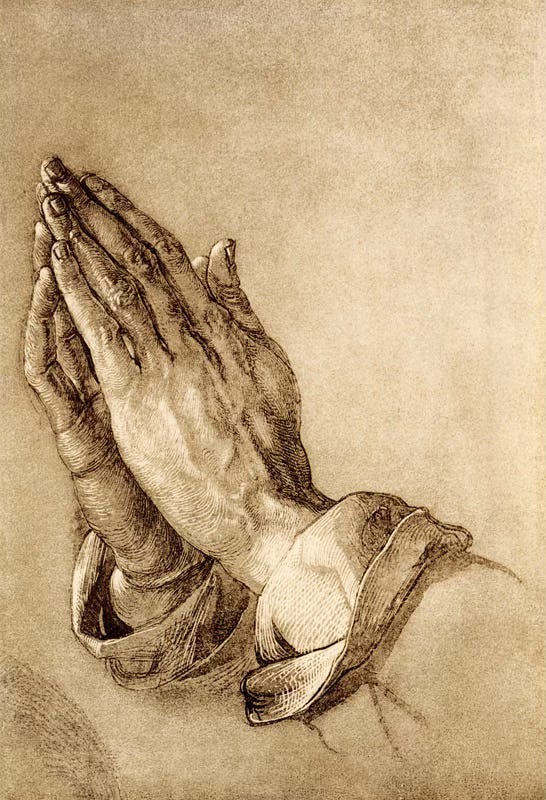
I normally am against the use of visuals in a story. Using props or flashing images on a screen, tends to break ‘the story spell’ and remind the hearer that they are in a room listening to someone speak. I would make an exception here because the image comes at the very end of the story. Also it is such an indelible image, the hearer is going to naturally want to see it.
THE GIVING TREE
I almost didn’t share this story because it is so familiar. I can think of no story that better exemplifies self-giving love, though. So, while I doubt I’m introducing this story to you, perhaps seeing it here will give you the idea to use it.
A picture book is my other exception to the ‘no pictures’ rule. Picture books have been thoughtfully designed to cast a story spell using images and accompanying text. The images and text often work together in subtle ways, each one supporting the other. For the same reason, I advise you break one of my other rules: ‘Don’t read the story, know the story.’ The language used in the text of a really good children’s book (and this is one of the best) is especially designed to be economical and evocative. It’s also written ‘for the ear.’ So, if you can, read the text and show the pictures. JUST THIS ONCE!
So this may be a good place to talk about tears. This is an emotional story. And your getting emotionally caught up in it is not a bad thing. I got a little teary eyed reading it again. If your voice breaks and you have to take a beat before continuing, it can be a powerful moment. What you want to avoid, though, is a situation where you lose control and are crying in a way that is distracting. The reason is that the hearer will be pulled out of the story and suddenly be concerned for you. Is the pastor okay? She seems distraught… is it because her mother died last year?
So my best advice would be to practice reading it out loud before reading it to the congregation. You can read it out loud to yourself. Then, if you have small children in your life, they will be all too happy to let you read it to them (maybe even multiple times!). If you find that you are simply incapable of reading this without sobbing, you may consider asking the chair of finance to read it. That man has no heart.
THE BEGGING KING
I am not a Deepak Chopra reader. I don’t stand in judgement against those who are, it’s just not my scene. I was surprised to find this story in my files. It’s likely that it appeared in a newsletter and it struck me as the sort of story I might like to tell. So I copied it and pasted it into my note app, then added some keywords that would help me retrieve it later. It was the keyword: generosity, which lifted it to my attention this week. The point I’m making is that there is no way I would have remembered this gem of a story if I hadn’t taken a moment to capture it. A story capturing system is worth its weight in gold.
This story captures something of the dance of self-giving love. Christ pours into us as we pour into others. It is a mystery that we find our greatest glory in humility.
I was actually kind of bummed to learn that I had already shared THE KING AND THE MAIDEN. This Kierkegaard classic seems tailor made for Philippians 2.