

HOW IS IT POSSIBLE?
Sermontelling John 3:1-21 (NL 423)
BIBLETELLING
Below is the Narrative Lectionary passage for the coming week. It is followed by Bruce’s notes on the text which aim at a general understanding of the text and some notes on the structures and techniques used by the Biblical storytellers.
There was a Pharisee named Nicodemus, a Jewish leader. He came to Jesus at night1 and said to him, “Rabbi, we know that you are a teacher who has come from God, for no one could do these miraculous signs that you do unless God is with him.”2
Jesus answered, “I assure you, unless someone is born anew, it’s not possible to see God’s kingdom.”3
Nicodemus asked, “How is it possible for an adult to be born? It’s impossible to enter the mother’s womb for a second time and be born, isn’t it?”4
Jesus answered, “I assure you, unless someone is born of water and the Spirit, it’s not possible to enter God’s kingdom. Whatever is born of the flesh is flesh, and whatever is born of the Spirit is spirit.5 Don’t be surprised that I said to you, ‘You must be born anew.’ God’s Spirit blows wherever it wishes. You hear its sound, but you don’t know where it comes from or where it is going.6 It’s the same with everyone who is born of the Spirit.”7
Nicodemus said, “How are these things possible?”8
“Jesus answered, “You are a teacher of Israel and you don’t know these things? I assure you that we speak about what we know and testify about what we have seen, but you don’t receive our testimony. If I have told you about earthly things and you don’t believe, how will you believe if I tell you about heavenly things?9 No one has gone up to heaven except the one who came down from heaven, the Human One. Just as Moses lifted up the snake in the wilderness, so must the Human One be lifted up so that everyone who believes in him will have eternal life.10 God so loved the world that he gave his only Son, so that everyone who believes in him won’t perish but will have eternal life. God didn’t send his Son into the world to judge the world, but that the world might be saved through him.11 Whoever believes in him isn’t judged; whoever doesn’t believe in him is already judged, because they don’t believe in the name of God’s only Son.
“This is the basis for judgment: The light came into the world, and people loved darkness more than the light, for their actions are evil. All who do wicked things hate the light and don’t come to the light for fear that their actions will be exposed to the light. Whoever does the truth comes to the light so that it can be seen that their actions were done in God.”12
John 3:1-21 [CEB]
THREE STORIES
The following three stories pair well with the Narrative Lectionary passage for the coming week. They are followed by Danny’s sermontelling footnotes which explore the stories’ theological connection to the passage as well as insights into craft and performance. Our advice is to read the story first before digging into the footnotes.
THE MAN FOR WHOM THE SUN BROKE THROUGH
The talmud tells of a wealthy and influential rabbi living in Jerusalem during the first century named Guri. According to the talmud, Guri was a member of the Sanhedrin and renown for his generosity. It is said of him that when he would walk from his home to the place where he taught his students, fresh wool cloths were spread beneath his feet. The poor, following behind, would roll them up and be allowed to take them home.
During the three year siege of Jerusalem leading up to the destruction of the temple, the talmud mentions Rabbi Guri as being one of three men of great wealth who offered their out of their own abundance to help keep the people fed.
One of the most famous stories about Rabbi Guri comes from the time there was a great drought in Jerusalem. A festival was approaching and Guri knew that hundreds of thousands of pilgrims would soon descend on the city with thirsty livestock and there would not be enough water because all of their cisterns were nearly depleted.
So Rabbi Guri, because he was wealthy and influential, was able to go to a Roman official and strike a deal. He asked the official to loan him 12 cisterns of water with the promise that he would pay it back at an agreed upon date. Guri said that if he was unable to give back the 12 cisterns of water, then he would give the official 12 talents of silver.13
Now this was a large sum of money, even for a wealthy man like Rabbi Guri. Today it would be several million dollars.
The Roman official agreed to these terms and the festival was saved! But during the months following the festival, the drought dragged on and the 12 cisterns remained empty. It looked like Rabbi Guri would be reduced to poverty in order to pay back his debt.
The morning of the agreed upon date, the official sent a messenger to Guri’s door. He said, “Either return the water I lent you or give me the money you owe me!”
Still a drop of rain hadn’t fallen on the land and the cisterns were bone dry. Guri said to the messenger. “There are still plenty hours of light. The day is not over.”
At noon, another message came. “Return the water I lent you or give me the money you owe!”
Guri said, “There is still day light. I have time!”
Then came the afternoon sacrifice. The same message. “Return the water or give me the money!”
Guri said, “There’s still daylight!”14
When the official received this message, he laughed. “It has not rained a drop all year! Will it now rain enough in the next few hours to fill twelve cisterns?” The official went to the bathhouse in joy.
Guri went to the temple in sorrow. He wrapped himself in his prayer shawl and called out, “Master of the universe, to You it is clear that I made this commitment not for my own glory or for the glory of my father’s house-I made it for Your glory, so that water might be made available for the pilgrims.”
No sooner had Guri spoken these words than the sky became covered with clouds and so much water came down that all the cisterns in Jerusalem were filled to overflowing.
Rabbi Guri came out of the temple at the same time that the official was coming out of the bath and they met each other in the road. Rabbi Guri smiled and said, “Will you be paying me for the additional water I have given you?”
The official replied. “It may be that your God has shaken the world for you but, look, it is too late. The sun has already set!15 The water has fallen on cisterns which you have returned to me empty!”
Guri hurried back into the temple and wrapped his prayer shawl around himself once more. He prayed, “Master of the universe, make it known that You have beloved ones in Your world.”
Immediately the wind began to blow and the clouds parted, to reveal that the sun, though low in the sky, had not yet set. The official was crestfallen. “Now how can I argue against one for whom the sun breaks through.”
From that day on, Guri was known as Nakdimon16 “the man for whom the sun broke through.” Many scholars believe this Nakdimon ben Gurion of which the talmud speaks is the same Nicodemus17 who John’s gospel describes coming to Jesus at night!18
~ my retelling of story from the Talmud
THE SECRET DISCIPLE
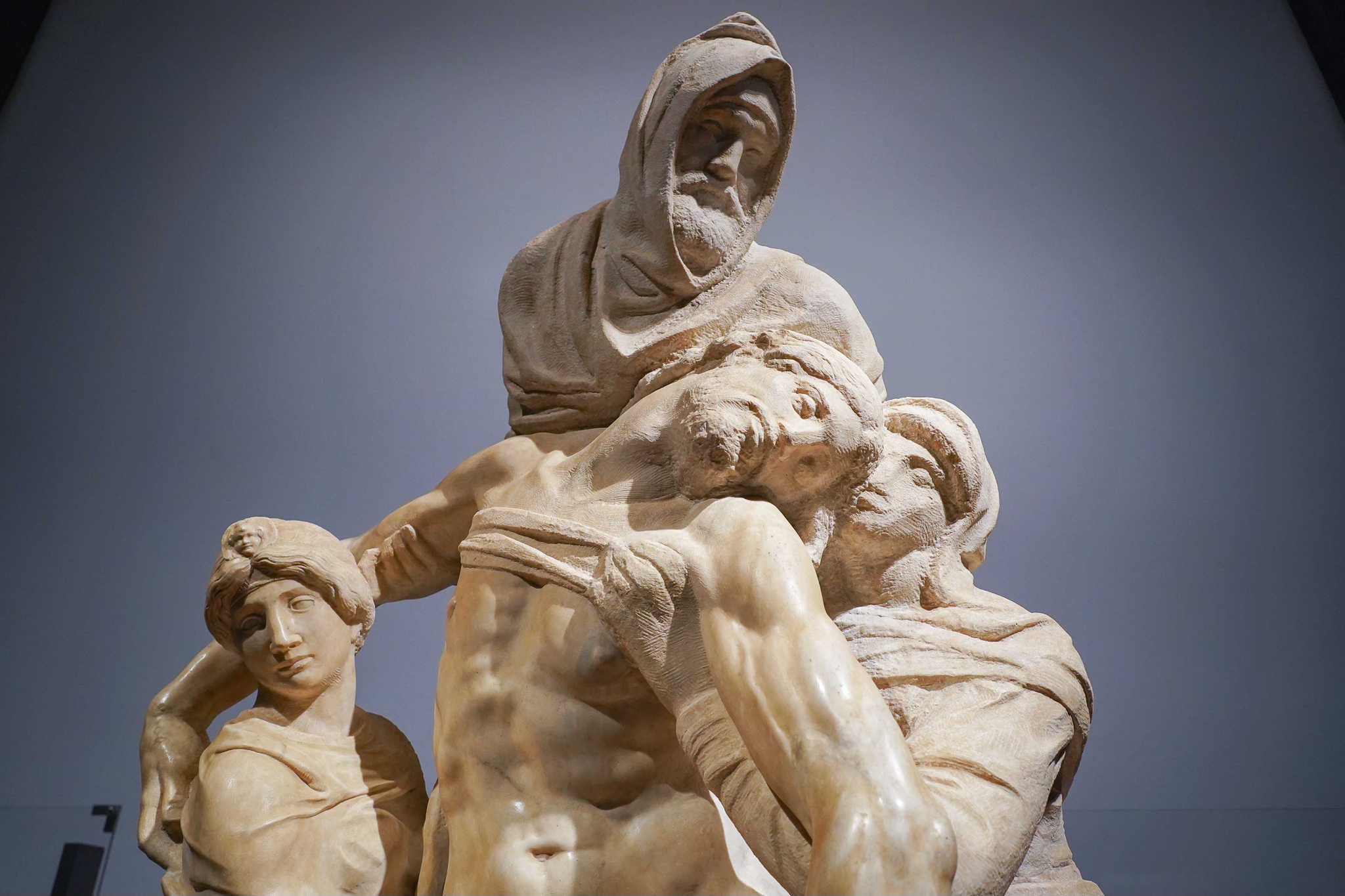
I want to show you one of my favorite sculptures. This sculpture is known as the Florentine Pieta.19 It was done by none other than the master renaissance sculptor, Michelangelo during the final decade of his life. The Florentine Pieta depicts Jesus being wept over by his mother Mary and Mary Magdalene, just after being taken down from the cross. This was a popular motif during the renaissance. Michaelangelo’s pieta differs from the standard depiction in that it features, quite prominently, a third figure: that of a mysterious hooded man.20
The Florentine Pieta was a passion project that Michelangelo continued to work on between commissioned works, often late into the night. He wrote in his journal that the sculpture was his obsession. He meant it to decorate his tomb. Then one night, in an apparent fit of rage, he destroyed it with a hammer. And never returned to it!
Shortly before his death, Michelangelo gifted the statue to a friend who had it reconstructed. Even with the cracks, the missing leg, and the face of the Magdalene restored by a lesser artist, you can tell: it’s a masterpiece.
So why did Michaelangelo destroy it? Why did he take a hammer to it in the dead of night? To answer that question, we have to turn our attention to the identity of that mysterious hooded figure. Though some art scholars insist that the figure is Joseph of Arimathea, most agree that the mysterious hooded man is none other than Nicodemus.
In John’s Gospel, Nicodemus is referred to as ‘the one who visited Jesus at night.’ For this reason he is usually depicted wearing a hood in European art. He is the eternal archetype of ‘the secret disciple.’ The one who believed in Jesus but never told the world. He is always depicted as carrying out his faith in background and shadow, never stepping into the light. This sculpture perfectly captures Nicodemus towering over Jesus, wrapped in a hood, both looking and not looking at Jesus. Adoring him with his face slightly turned so as to allow himself just a little bit of deniability. It’s perfect. So why did Michelangelo take the hammer to it?
Believe it or not, our mystery takes us away from Italy to a heretic monk in Germany named Martin Luther. When Martin Luther launched the Protestant Reformation, it was a revolutionary moment in time! Luther proclaimed that all people needed for their Salvation was faith in Jesus Christ alone (not the sacraments of the Church). And he invited every Christian to read the Bible for themselves rather than simply accept what the Church said it meant.
Believe it or not, there was a time when this was considered heresy. Soon, after all of Europe was divided. Those nations that followed the teachings of the Pope, remained Catholic, and those that followed the teachings of Martin Luther, became Protestant.
In Italy there was a group of people who believed in the new teaching. They met together and read the Bible and discussed their belief in salvation through simple faith in Jesus Christ. They were Protestants but they dare not tell anyone. Afterall, Rome was the home of the Vatican. To go against the Pope would be to risk everything: status, livelihood, perhaps even death. So these Protestants met together in the dark of night and professed their beliefs only to each other. In public they venerated the Virgin Mary, went to Mass, and confessed their sins to the priest. But in private, they read scripture together and discussed salvation by faith alone. Because this group only practiced their true faith in the dark of night, they were known as the Nicodemites.
Among their number was the famous sculptor Michelangelo Buonarroti. Despite, privately holding to the teachings of Luther, he still continued being employed as one of the Vatican’s great artists. It didn’t matter what he said in public. People still whispered. Everyone knew Michelangelo was a Nicodemite. In many ways the label fit Michelangelo especially well. After all, he and Nicodemus had much in common. Both were wise and learned men, both were curious about Jesus, and both did their best work at night. Perhaps Michelangelo especially identified with Nicodemus. Maybe that’s why he included him in that sculpture that obsessed him for a decade.
Art historians tell us that the features of the mysterious hooded man were none other than the features of Michalangelo himself. In this sculpture he was capturing Nicodemus’ final moment in which he steps into the light and worships Jesus with burial spices. No more hiding in the shadows and bringing change about from the inside. Perhaps this was meant to be Michelangelo’s coming out piece. Yes! I AM who you say I AM! It is true! Like Nicodemus I have practiced my beliefs in the shadows, but now like him, I am worshiping my Savior in the open! This sculpture will stand forever at my tomb as a testament to my true faith.
Maybe.
But Michelangelo lost his nerve. 1n 1555, Pope Paul IV was coronated. This new Pope immediately opened an Italian inquisition to root out secret Protestants. That is: Nicodemites. So it was that, one night in 1555, Michelangelo took a hammer to his masterpiece. It was too provocative. Too dangerous. If he was ever tried, it would surely be used as evidence. Michelangelo wouldn’t be stepping into the light just yet. He, like so many before, remained a secret disciple. Afraid to proclaim in the day what he knew by night to be true.21
THE GIRL WHO STOOD UP TO THE TORNADO
Once there was a little girl who stood up to a tornado.22
The tornado was bearing south. It was twisting and turning violently around its hollow empty center. And it was going to destroy her village. So the little girl stood on a hill and shouted at the tornado:
“Tornado, turnaround! Do not destroy my village!”
The tornado was startled. No one has ever talked to him like that before.
“Where would you have me go?” Asked the tornado.
“Turn around and go North!” The girl said.
“If I go North, there is another village just like yours. And there are people just like you who live in that village. Their homes will be flattened and they will be killed. Is that what you want?” asked the tornado.
“Of course not,” said the girl. “Go East into the desert.”
“If I go East into the desert, I will become a sandstorm. And there are people there who live in tents. Their tents will fly away and they will be buried in the sand. Is that what you want?” asked the tornado.
“Or course not,” said the girl, “Go West into the sea.”
“If I go West into the sea, I will become a hurricane. And there are people there who live on the islands. Their homes will float away and they will be lost in the flood. Is that what you want?” asked the tornado.23
“Of course not,” said the girl.
The tornado was almost to the little girl’s village. The sun was blotted out. The trees were bending over backwards. Debris was flying through the air.
“Don’t go anywhere!” she cried out, “Slow down! Stop your violent twisting and turning! Let go of your hollow empty center! And stop being a tornado.”
This thought terrified the tornado.
“If I stopped being a tornado, what would I be?”24
“Once you stop your violent twisting and turning, once you let go of your hollow empty center, you will be free to be anything you want to be. You could be the cool spring breeze that brings rain to the flowers. You could be the swift summer wind that lifts the wings of the eagle. You could be the autumn guide that shakes the leaves loose from their limbs and leads them to their final resting place. You could be the breath that carries the songs that children sing when they gather together in winter. There’s no end to what you could be if you would only let go…”25
~ original parable
From the Archives: GERONIMO THE GRUB
“You really are the most inquisitive creature I have ever come across. Since you’re so eager to find out what lies above, I’ll give you a ride upon my back and you can see for yourself,” the frog offered, exasperated by all the questions.
Geronimo was delighted. He climbed onto the frog’s back and up they went! But the moment they reached the surface-crash! He reeled back into the pond, gasping for breath. He clung to the stem of a water plant, trembling with shock and disappointment, until the frog joined him.
“There is nothing beyond this pond but death,” he wept. “Why did you tell me all those stories about beautiful colours and bright light?”
SERMONTELLING NOTES:
Most scholars take special note that Nicodemus comes to Jesus “by night,” though opinions vary on why this would be significant. Some suggest that Nicodemus is coming in secret, under cover of darkness. Others suggest that John is using the darkness as a metaphor for Nicodemus’ inability to understand what Jesus has on offer.
What is seldom discussed is that this incident takes place during the celebration of the Passover, perhaps on Passover evening itself. For Jews, this evening is called the “night of watching.” The Talmud—a Jewish document that probably reflects rabbinic thought dating back to before the time of Jesus—suggests that Israel’s final and decisive deliverance will come during the Passover season just like their initial rescue from Egypt.
If Nicodemus’ questions are about Jesus’ identity as the Messiah, they would be very much at home on this evening of watching.
As always, though, John is capable of meaning more than one thing when he chooses a particular word or phrase."
Nicodemus speaks very highly of Jesus. Sometimes we view this as a smoke screen. Nicodemus butters Jesus up, even though his intent is to trip Jesus up in debate.
Again though, this admiration may be genuine. “We know that you must be from God…” But are you the Messiah? Is tonight the night?
If Nicodemus’ intent is to determine if Jesus is the Messiah, then Jesus’ mention of entering the Kingdom of God is not a change of subject. The coming of the Messiah and the coming of God’s Kingdom are bound to each other in ancient Judaism.
Rabbis in Jesus’ time often spoke of being “born again” as what happened when a Gentile converted to Jewish faith.
Nicodemus’ question is often taken to be infantile. The assumption is that he is so absorbed in the material world that he cannot see that Jesus is speaking metaphorically. It seems far more likely that Nicodemus, a man of great learning, was following Jesus very clearly and responding with a metaphorical question of his own:
You say that we need to be converted. But we are already faithful Jews! Why must we be converted?
Conversions to Judaism were often accompanied by a water baptism. Jesus reminds Nicodemus that it is not the water which converts, however, but the work of the Spirit. Nicodemus is probably nodding along up to this point. A wise rabbi would be looking for more evidence of conversion than simply a willingness to go through a ceremony. They would be looking for evidence of a changed life.
Nicodemus should not be surprised that a new work of God’s spirit, one that initiates the Kingdom of God, might require that God’s people undergo a new conversion.
Wherever the Spirit leads will require a renewal of commitment on the part of God’s people.
Nicodemus has trouble reconciling what Jesus is saying. Are God’s faithful really in just as much need of renewal as the pagans?
Jesus’ senses that Nicodemus has come for answers to even bigger questions than questions about Israel’s need for renewal. Nicodemus wants to know if Jesus is Messiah and the Kingdom is at hand. However, if the teacher cannot grasp the need for renewed commitment on the part of God’s people (something Jesus thinks obvious to the human eye) he will be no more likely to understand the picture of “Messiah” that Jesus is committed to living out.
Greek manuscripts contain no quotation marks (or other punctuation!), so it is unclear in the original text just exactly where Jesus’ answer to Nicodemus ends and where the narrator begins to make commentary on the conversation. Some translations place that break here (between verses 12 and 13.) Others place it between verses 15 and 16. Still others do not close the quotes until the end of verse 21.
On the one hand, the text shifts from first person (Jesus clearly referring to himself as “I”) to third person (the text referring to Jesus as “the Son of Man” and “he/him”) between verses 12 and 13. Making the break at this point also results in Jesus ending his discourse with Nicodemus by asking a question, which seems like a very “Jesus” thing to do.
On the other hand… verses 13-15 appear to constitute a riddle of sorts—also a very “Jesus” move. The riddle, in fact, is exactly the sort of riddle Jesus might pose to a teacher of the Torah…
Verse 13 introduces the term “Son of Man” (translated in the CEB as “Human One.") The term is clearly a reference to Daniel 7, in which “one like a son of man” is arrives in the presence of God on his throne. This figure is given dominion over all of the world’s kingdoms and receives worship from people from all over the world. His is a kingdom without end. John (or Jesus!) insists that this eternal king has come down from heaven and awaits his final exaltation and rule. John’s readers will take this figure to be Jesus himself and his exaltation to signal the beginning of the Kingdom of God.
The impact of the riddle hinges on some word play. The Greek word hypsoo can be translated as “exalt” or simply as “lift up.”
Verse 14 tells us that the Son of Man will be exalted (“lifted up”) in the same way that Moses “lifted up” the serpent in the wilderness. Again, the Hebrew Bible reference is clear. The “serpent” in question comes from a story in Numbers 21. During their wilderness wanderings, the Israelites begin to complain against God. In response, God sends poisonous snakes into the crowd, who bite the people, causing some of them to die. When the people repent, God instructs Moses to fashion a bronze serpent and place it on a pole. Anyone who was bitten by a serpent could look upon the bronze serpent and live.
The Son of Man will be “exalted” in a way that doesn’t look like exaltation at all, but looks like a mockery and appears to rob him of power. Nevertheless, this “lifting up” will result in bringing life to all who turn their eyes upon him.
If Nicodemus came asking Jesus whether he was the Messiah, Jesus answer (embedded in a riddle within a riddle) seems to be “Yes, but not in the way you probably think. My Messiahship will be of a very different sort.”
John 3:16 seems to follow so naturally from verses 14 and 15 that any suggestion to close the quotes after 15 seems unlikely.
The phrase “eternal life” in Greek is literally “life of the age.” I like to paraphrase it as “Kingdom Life.” In any case, it is much the same thing Jesus was talking about when he talked to Nicodemus about those who “see the kingdom” in verse 3:3.
Nicodemus comes to Jesus by night, and Jesus’ closing words to him are about light and darkness. Like being “born again” as discussed at the beginning of their conversation, those who “see the light” may be known by a changed way of living. Looking upon Jesus in faith, brings with it a new quality of “life.”
THE MAN FOR WHOM THE SUN BROKE THROUGH
I find the use of the number 12 in this story to be illuminating. Whatever its symbolic ties are to the 12 tribes of Israel, it also seems to function in the story as a number of abundance and plenty. Recall that in the gospels, there are twelve basketfuls left over after the feeding of the 5000.
The talmud uses a classic set of threes here. I have used an oral technique in my retelling I call ‘building a snowman.’ Like the parts of a snowman, each similar section is smaller than the last. You can see it in the officer’s demand. Notice how each time the demand is iterated, it is done so more succinctly:
“Either return the water I lent you or give me the money you owe me!”
“Return the water I lent you or give me the money you owe!”
“Return the water or give me the money!”
The effect of this technique is that the tempo of the story actually picks up even though you are revisiting familiar territory. This keeps the story from becoming monotonous.
The logic of this whole story is based on the Jewish understanding that the new day begins at sundown.
Nakedah is Hebrew for ‘broken through.’
I chose to PAUL HARVEY this story by obscuring the fact that the talmud calls him Nakdimon ben Gurion throughout (though we are told he receives that name based on these events) and went with what he was probably called: ‘Guri.’ And now you know… the rest of the story.
While many prefer to think of the Nocodemus of John’s Gospel as a fictional foil, those committed to finding a historical Nicodemus could hardly find a better candidate than the talmud’s Nakdimon ben Gurion. Both are described as being members of the Sanhedrin and wealthy men (Nicodemus assists in Jesus’ burial). Josephus mentions that Nakdimon had a second house in Galilee. Accepting this connection should change the way we see John 3, though. Because Nakdimon was most active during the Jewish Roman war, despite common depictions of him as wisened rabbi, we should expect him to be a young man during the time of Jesus. Wealthy and influential, because he is from an aristocratic family, but full of questions. What difference would it make to read this passage thinking not of an old dog who can’t learn new tricks but as a young teen who listens intently to Jesus’ talk of darkness and light, somewhat bewildered because he is not yet one for whom the sun has broken through. Perhaps his encounter with Jesus leads to him becoming ing the man the talmud remembers him to be: wise, generous, a man of prayer.
THE SECRET DISCIPLE
Normally, I caution against the use of visuals when telling a story. I argue that visuals sabotage the hearer’s ability to imagine the story. Here, the visual is so crucial to the story that it is worth showing at the outset. Once you have shifted the focus from the statue to the story, the hearer will naturally leave the visual behind and begin imaging the story you are telling.
A technique I have used to keep this bit of art history from becoming a dry recitation is the employment of mystery. I pose a series of questions that (ideally) cause the hearer to lean in and wonder what the answer will be. This first mystery: who is the hooded man? is solved pretty quickly. But the main mystery keeps the tension going: why did Michelangelo destroy an obvious masterpiece?
The utility of this story is that it helps the hearer think about the idea of ‘secret discipleship.’ In John’s Gospel, there is a clear contrast being drawn between Nicodemus and the woman at the well (who tradition calls Photine). Nicodemus is a Jewish man, a respected insider. Photine is a Samaritan woman, a disregarded outsider. Nicodemus comes in the middle of the night while Photine comes in the middle of the day (and if you don’t think day and night are important to John, you haven’t been paying attention). Both are presented with spiritual metaphors they struggle to understand. Yet Nicodemus disappears back into the shadows while Photine proclaims the Gospel to all who will listen. She risks the kind of rejection that Nicodemus is unwilling to. This is a challenge to us. Everybody probably knows we are Christians and few in our congregations are embarrassed about the fact that we go to truth. But how many of us are truly willing to share the good news when it goes against the prevailing political mood of the day? How many of us will risk social standing to speak Jesus’ truth when it is uncomfortable? How many of us slink into the shadows during moments that call for boldness? We can be public Christians and still be secret disciples.
THE GIRL WHO STOOD UP TO THE TORNADO
This is a strange parable that I wrote shortly after Hurricane Helene caused once in a generation flooding in my area and many of us were asking very Job-like questions. And yet that’s not ultimately what this parable is about. It kind of does a bait and switch. It starts off being about the questions we ask of God but it’s really about the questions he asks of us. Are we really willing to change? Would we really embrace the kind of scary transformation that would alter our relationship with God, our neighbor, and ourselves… or do we just want to be the same people we always were, just pointed in a different direction (like the old Mark Twain saw: I knew a man who was mean on alcohol but then he went to a tent meeting. Now by the grace of God he’s mean on religion.) I quite love this parable but haven’t had occasion to share it. But because it employs the imagery of questions and wind in a discussion about transformation, this seems as good a place as any.
Savvy readers will notice that this parable employs a 3+1 strategy. 3+1 is a variation on the rule of threes. Because our psychology is so wired to see three as a complete set, if the hearer is presented with three attempts that don’t work, a sense of narrative hopelessness sets in. I guess that’s it. The tornado can’t go North. It can’t go East or West. The tornado has to destroy the girl’s village.
The plus one always comes as an unexpected solution to the problem that is completely different than the set of threes. In this case, the plus one solution is don’t go anywhere. Stop being a tornado and be reborn as something else.
3+1 is a staple of folktales. Once you learn to spot it you will see it everywhere.
This is the million dollar spiritual question. If I surrender my life to God and submit to his transformation of my very being, what will I be? To be born again involves a kind of spiritual death. And even spiritual death involves a little existential dread.
When I told this in church, I chose to memorize this paragraph. While I don’t recognize memorizing stories because stories don’t exist as words so much as a series of images waiting to be recalled and described, certain lyrical phrases and passages are worth memorizing if they enhance your telling of the story,