

FAITHFUL THOMAS
Sermontelling John 20:19-31 (NL 440)
BIBLETELLING
Below is the Narrative Lectionary passage for the coming week. It is followed by Bruce’s notes on the text which aim at a general understanding of the text and some notes on the structures and techniques used by the Biblical storytellers.
It was still the first day of the week.1 That evening, while the disciples were behind closed doors2 because they were afraid of the Jewish authorities, Jesus came and stood among them.3 He said, “Peace be with you.”4 After he said this, he showed them his hands and his side. When the disciples saw the Lord, they were filled with joy5. Jesus said to them again, “Peace be with you. As the Father sent me, so I am sending you.”6 Then he breathed on them7 and said, “Receive the Holy Spirit. If you forgive anyone’s sins, they are forgiven; if you don’t forgive them, they aren’t forgiven.”
Thomas, the one called Didymus, one of the Twelve, wasn’t with the disciples when Jesus came.8 The other disciples told him, “We’ve seen the Lord!”9
But he replied, “Unless I see the nail marks in his hands, put my finger in the wounds left by the nails, and put my hand into his side, I won’t believe.”10
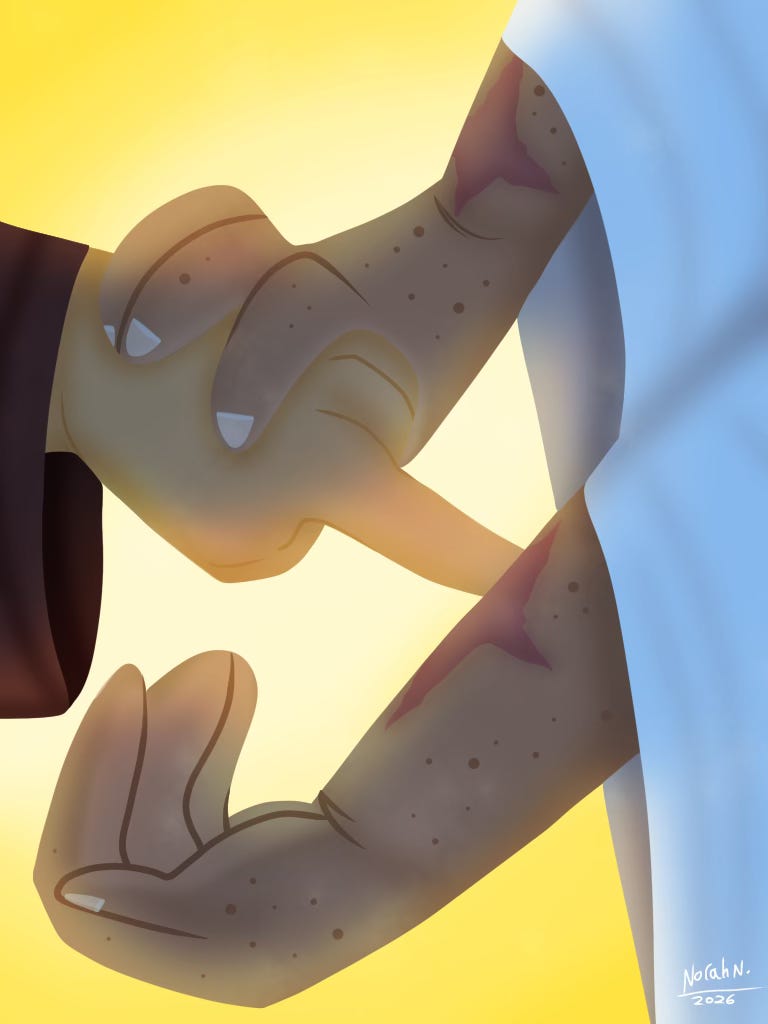
After eight days11 his disciples were again in a house and Thomas was with them. Even though the doors were locked, Jesus entered and stood among them. He said, “Peace be with you.”12 Then he said to Thomas, “Put your finger here. Look at my hands. Put your hand into my side. No more disbelief. Believe!”13
Thomas responded to Jesus, “My Lord and my God!”14
Jesus replied, “Do you believe because you see me? Happy are those who don’t see and yet believe.”15
Then Jesus did many other miraculous signs in his disciples’ presence, signs that aren’t recorded in this scroll. But these things are written so that you will believe that Jesus is the Christ, God’s Son, and that believing, you will have life in his name.16
John 20:19-31 [CEB]
THREE STORIES
The following three stories pair well with the Narrative Lectionary passage for the coming week. They are followed by Danny’s sermontelling footnotes which explore the stories’ theological connection to the passage as well as insights into craft and performance. Our advice is to read the story first before digging into the footnotes.
WHAT’S IN A NAME?
Doubting Thomas.17 That’s the moniker by which this Thomas is known throughout the generations by people of faith. Doubting Thomas.18 You would be forgiven for thinking Doubting was his first name. Thomas, Doubting. That’s how often we call him ‘Doubting Thomas.’
He had another nickname by which he was known among the disciples. He was called, Didymus, which means ‘the Twin.’ We’re never really told why. Maybe he has a twin at home. Or maybe he bears a striking resemblance to one of the disciples or Jesus, himself. People have speculated. The point is: all his friends called him ‘Didymus.’ But we don’t do him that favor. We call him ‘Doubting Thomas.’
And we use it pejoratively, too, don’t we? We say “don’t be a doubting Thomas…” We say it like doubting is the worst thing you could possibly do. “Don’t be like that Thomas… he… <gasp!> …doubted!”
I don’t think that name is very fair. When we look at Thomas in the full context of his life as described in the gospels, we find someone who is faithful. Faithful Thomas! I think we should try and get that name going. Maybe we can start it here and it will catch on. Faithful Thomas.
The first story about Faithful Thomas19 is in the 11th chapter of John. Jesus' friend Lazarus is sick, and after waiting for a couple of days, Jesus announces, “We’re going back to Judea!” The disciples tell Jesus, “We don’t think that’s a very good idea. The Judeans do not like you. The last time you were in Judea, they tried to stone you! Anti Jesus sentiment is at an all time high! Maybe you should sit this one out...”
Jesus says… well he says a lot of things but it basically boils down to, “Do what you want. I’m going.”
Then it’s Thomas who speaks up and says, “Let us also go, that we may die with him.”
Thomas is willing to go with Jesus no matter the cost.20 Doesn’t that sound faithful to you? Faithful Thomas.
Then, in the 14th chapter— it’s the last supper —Jesus has just announced that someone is going to betray him and that Peter will deny him three times. Think about what the mood is like in that room! Then Jesus breaks the news to the disciples that he is getting ready to abandon them. Not exactly, but that’s how they take it. He tries to comfort them by telling them that he is only leaving them for a temporary period while he prepares a place for them in his father’s house. “Don’t worry,” he says, “You’ll join me when the time comes! You know the road to take to get where I’m going.”
But Faithful Thomas, who would follow Jesus anywhere, is not having it. He needs to make sure he will able to get wherever it is that Jesus is going. He says: “Lord, you haven’t told us where you’re going. How will we know which road to take?”21
Jesus says, “I am the road… and the truth… and the light. The way to the Father is through me!”
See Thomas is not going to let Jesus leave without the assurance that he’ll know how to get to him later. He wants to know the way! Doesn’t that sound faithful to you? Faithful Thomas.
Now Easter Sunday rolls around. The disciples have locked themselves inside. There’s a bolt on the door. Why? Because they’re afraid that the same Judeans who arrested Jesus will arrest them too. But you know who isn’t cowering inside. You know who is out and about, not afraid of being snatched off the street and forced to answer questions about his relationship to Jesus? You guessed it. Faithful Thomas.
So, yes, Thomas missed it when Jesus walked through the wall and said, “Peace be with you!” Thomas missed it when Jesus showed them the marks in his hands and the wound on his side. He missed it when Jesus breathed the Holy Spirit into them and gave them their marching orders. But he missed it because he wasn’t inside cowering like the others.
When Thomas gets back to the house, he finds the door bolted shut just like he left it. So when the disciples say, “We have seen the Lord,” he is not ready to take their word for it. He needs to experience what they’ve experienced for himself. He needs to hear Jesus’ voice for himself. See the nail marks and the scars. Feel them, himself. Then he’ll believe. You can this ‘doubting’ but isn’t that what we tell young people? Don’t believe because someone told you… experience Jesus for yourself!
And a week later, Thomas is still showing up. For seven days he’s waited for Jesus in the last place he was seen. Instead of moving on with his life. Instead of saying, “These disciples are crazy, I’m going back home to Galilee.” He shows up. He waits. Yes, he has questions. But even in his doubt, he is faithful.22
And when Jesus finally shows up a week later and says, “Peace be with you! Put your finger here; see my hands. Reach out your hand and put it into my side. Stop doubting and believe.”
It’s not a rebuke. It’s an invitation. Jesus rewards his questioning. His fearless pursuit of the truth. And Thomas, once he sees Jesus, doesn’t even need to put his hands in the scars. He’s ready to believe. He makes the boldest declaration of Christian faith in the Gospel of John. He says, “My Lord and my God!”
It’s a leap no one else is ready to make. Peter will need another miracle to really get his head around it. But Thomas makes the unintuitive leap from ‘Jesus, you’re back’ to ‘Jesus, you’re God.’ It’s the kind of leap you can only make when you surrender yourself to a mystery you don’t understand and you know you never will. But you believe it anyway because you know in your bones that if you hold on to it, it will hold on to you. That’s the kind of leap all of us are called to make when we encounter Jesus. We are all called to put our whole trust in him as the God of the universe and the Lord of our lives. It’s a great big leap! One few people can make? Can you? Can you be like Faithful Thomas?
~ My Retelling of John 20:19-31
THE CAVE OF DOUBT
Once there was a tiny convent in the middle of the woods.23 In the convent there lived a young novitiate who had spent her whole life within its walls. She loved that little convent. She loved listening to the nuns tell Bible stories. She loved praying in the chapel and hearing the sweet voice of God in the silence. She loved her work and her relationships and she was dedicating to being a nun herself like the women who had raised her.
But there was one thing about that tiny convent that always bothered her. On the furthest back wall, out past the prayer garden, there were two great wooden doors that said ‘KEEP OUT!’24 She had been told from a very early age that the doors led someplace dangerous and that she should never go near them. Someday, if she became a nun, she would be granted the key but until then she would do well not to think of it. Be a good little girl. Run along and play.
But it was hard not to think of it. All while she was growing up, she would see the occasional nun come out from behind those mysterious doors, make sure no one was watching, then quickly lock them behind her. And the girl would wonder to herself, “What’s back there?”
Eventually the girl grew into a young woman and became a novitiate.25 One day she was in the prayer garden when she saw one of the nuns coming out of the doors. Only this time she’d forgotten to lock them behind her. So, unable to contain her curiosity, the novitiate went through the doors. They led her to a small area surrounded by walls except for the mouth of a giant cave. When the novitiate went to the mouth of the cave, she discovered that it was deep, dreadful, and dark. And somewhere in her soul she almost felt as if the cave was whispering to her.
Frightened, she ran back into the convent. That night, she barely ate, barely slept. All she could think about was the cave and her guilt at disobeying the nuns’ orders. That morning, after prayers, she went to the reverend mother and confessed what she had done. The reverend mother, after chastising the novitiate for being disobedient, revealed to her the secret of the cave.
“Since you are a novitiate, it’s probably time to tell you about the cave anyway. That cave is called the Cave of Doubt. It is a dark and dangerous place. We keep it locked up so that young girls won’t wander into it. We do this because many who wander into it never come back out. We have considered walling it off completely but it does serve an important purpose. See even good nuns sometimes have questions. Questions about life and God and faith. Questions we are afraid to ask each other. The Cave of Doubt is where a nun can go and ask those questions. They’ll go into the Cave and call out their question and an answer will come echoing back. But here’s what makes the cave so dangerous: the echoes come back as faintest whispers. In order to hear them, a sister must step several feet deeper into the cave. So the more questions she asks, the further and further into the darkness she goes. Most play it safe and ask one question, maybe two, so that they can still see the light behind them. But many sisters have gone into the cave and never returned. None of us knows exaxtly what happens to them. Perhaps they fall into a bottomless pit. Or there is some terrible creature in there that lures them in with whispers. Or maybe they just lose track of the light and find themselves lost forever. So now you know. The Cave of Doubt is an unavoidable part of our life of faith together. There will be times when you have to ask a question, but in those times you must proceed with caution and be careful that you don’t ask so many that you become irretrievably lost.”
So the young novitiate tried to put the cave out of her mind. She went on to become a nun and she was given her own set of keys to the wooden doors. But that one experience with the cave haunted her so much that she kept them under her mattress and she never used them, out of fear of what might happen if she did.
But as the new nun grew in her faith , that tiny convent started to feel very cramped. The stories the nuns told didn’t do much for her any more. The silence of her prayers no longer comforted her; it mocked her. And her work and life started to feel dull and meaningless.
Then one day, it dawned on her. She had questions. Questions she dare not ask any of her fellow sisters. Questions which nonetheless needed answers.
So she went to visit the Cave of Doubt. When she stood at the mouth of the cave, it still seemed dreadful, deep, and dark. She trembled as she felt a whisper, she couldn’t quite make out, beckoning her deeper inside. But she stepped into the cave and, as she walked a few steps into darkness, the faint whisper she could feel became a voice that she could hear. It said, “Tell me what you wonder…”
The nun called out into the darkness, “Does God hear me when I pray?”
Then she felt a faint whisper once more, and stepped deeper into the darkness so that it would become a voice that she could hear.
Now I can’t tell you exactly how the cave answered that question. The whole point of the cave is to wonder in private what you can’t wonder outloud. All I can tell you is that this question led to more questions. Deeper darker questions. And these questions led her further and further from the light and into the black night of the cave. And as she asked each question, she found courage to ask more. Pretty soon the mouth of the cave behind her had become only a faint point of life.
She looked behind her and realized she was on the verge of going too far. But she had more questions. Questions that needed answers. Answers she couldn’t return to her tiny convent without. So she thought, “If I keep walking straight, then I only need to turn around when I’m finished and I’ll walk back toward the light. And so she asked her next question then stepped into perfect darkness.
Pretty soon, she kept asking and asking and she wasn’t really sure if she was walking straight or not. It felt like maybe the whisper was leading her in zig zags and circles. Suddenly she realized it had happened.
She’d lost her way. She was lost. She didn’t know whether she was on the precipice of a dark pit or inches from the jaws of a terrible monster. The only thing she knew was that she was alone and that she may never see her family of nuns again. In this moment she longed for their stories, the soft silence of her prayers, and their simple life and work together. She had ruined everything by letting her curiosity get the better of her. She’d been a fool to let her wonder lead her so far into the darkness. But now there was no giong back. This was her life now. If she never saw the light of day again, well, at least she would have answers.
So she stood up and shouted another question. Then she followed the whisper to a voice. Again and again she dared to ask. Troubling questions. Twisted questions. Questions that would make your hair stand on end just to hear them. She just kept asking and going further and further until she could think of no more questions to ask and then— she saw it.
A tiny point of light. Oh what a relief. She must have somehow got turned around and here she had come full circle! So she ran toward the light. It was blinding now. She ran straight into the brightness and she was finally out of the cave. But when her eyes adjusted, she realized that she wasn’t back where she had started at all.
She was on a hillside overlooking a great big covent. As she looked down, she could see smiling happy nuns enjoying their life together. She saw vast grounds, a great big chapel, libraries full of books, fields, and vineyards. It seemed like an endless convent that she would never get done exploring.26 And outside its walls were villages full of people which the nuns went to every day to serve and teach. She ran down the hill and knocked on the door of the convent. To her surprise she was greeted at the door by a familiar face. It was a nun who had disappeared into the cave many years before. In fact, behind her, in the convent, were the faces of countless other nuns who had gone missing over the years.
The nun at the door smiled and said, “Welcome home, sister, I see you’ve just passed through the tunnel of faith!”27
~ Original Parable
DEVIL IN DISGUISE
Once upon a time the devil was determined to get into heaven.28
To achieve this, he disguised himself as Jesus. That way, he felt sure, no one would dare to refuse him access to heaven. That would be unthinkable.
Now it happened that on the day in question St Peter was away on heavenly business and St Thomas had been left in charge of immigration. St Thomas, you will remember, was the disciple who doubted Jesus’ resurrection, and insisted on seeing Jesus’ wounds before he would be convinced.29
Well, things were quiet at check-in when the devil appeared, looking for all the world like the risen Jesus.30 Thomas duly stopped him at the pearly gates and after a few minutes of careful consideration he refused him entry. When the other disciples heard what had happened they were horrified. “How could you have refused to let Jesus into heaven?” they demanded.
“That wasn’t Jesus,” he replied with calm conviction. “It was the devil.” “But it looked exactly like Jesus,” they retorted. “How could you be so sure?”
“The devil has no wounds,” said Thomas quietly.31
~ Margaret Silf
From the Archives: THE EGG & SPOON
A recent high school graduate sat in his pastor’s office and confessed that he was worried about going to college.
“Why are you worried?” she asked him.
“I know that when I go to college, I will be exposed to different people, new experiences, and challenging ideas. And I’m worried that in the midst of it, I may lose my faith.”
The pastor smiled. “I had a feeling that’s what this was about. Come with me.”
SERMONTELLING NOTES:
This will be the third resurrection story in John’s gospel which takes place on that first Easter Sunday. The first two are somewhat intertwined, beginning with Mary Magdalene finding the stone rolled way from Jesus’ tomb. She runs to tell the apostles. The storyteller shifts our attention at this point to Peter and the beloved disciple running to the tomb and entering. What they see there is puzzling, as we are told they did not yet understand the story of the resurrection. Nevertheless, at least one of the men is moved to faith and they return to the place they had been staying.
Our attention is returned then to Mary Magdalene, who has a personal encounter with Jesus. She initially mistakes him for a gardener, but when Jesus speaks her name, she recognizes him. He tells her not to touch him because he has not yet ascended to the Father. Instead, he sends her with a message for his “brothers” about his eminent ascension to “my Father and your Father, to my God and your God.” She is faithful to do so, adding her personal testimony “I have seen the Lord!” to the words Jesus had asked her to carry.
I’m taking a moment to remind us of these two previous interwoven stories for a couple of reasons. One reason is that it’s always a good idea, when interpreting a passage, to be aware of what comes immediately before and after it in the text. If you’re pressed for time and don’t have time to look at both the “before” and “after” passages, then at least look at the one look at the one “before.” A second reason is that today’s passage is also composed of two interlocking stories, and there is something to be gained by noticing parallels between these two pair of stories.
The two stories told in John 20:1-18 take place at an open tomb. The two stories we look at today take place (like a great mystery novel) in a locked room. In light of the events in today’s first story, I actually think this is a clever piece of storytelling. Jesus has calmy walked out of his own tomb, but the disciples, driven by fear, have locked themselves in.
Jesus enters into the locked room, apparently without using the door. Gathered together in their own symbolic tomb, the disciples discover they are not alone.
Jesus will repeat “Peace be with you” once again in just a few lines. On the one hand, “Peace,” or “Shalom” will have been a standard Jewish greeting. However, Jesus has re-loaded this phrase with a new level of meaning during his time with the disciples in the upper room (John 14:26-27) where he promises a peace unlike that which the world offers which will accompany the gift of the Holy Spirit. It is no coincidence that in this passage Jesus offers “Peace,” the imparts the Holy Spirit, then repeats his offer of “Peace.
Like his offer of peace, Jesus had promised his disciples this moment of joy during the upper room discourse (John 16:20).
In addition to the imparting of the Holy Spirit, also sandwiched between his two proclamations of Peace, Jesus gives the disciples a commission, sending them “as the Father sent me.”
In Jesus’ day, the Hebrew Scriptures were widely available in a Greek translation we call the Septuagint. The Greek word John uses to describe how Jesus “breathed” on the disciples is an exact match with the Greek word used in the Septuagint for how God breathed life into Adam and later (Ezekiel 37) breathed life into the dry bones in Ezekiel’s famous vision. Jesus has entered into the disciples’ figurative tomb and breathed life into them.
We have a small glimpse, here, into the character of Thomas. While the other disciples are locked in out of fear, Thomas is out and around doing something.
The disciples share their joy with Thomas using the same language Mary Magdalene used when she had reported to them (John 20:18). This verse also serves as a transition between the first and second story of today’s pairing. As in the two stories featured in the first half of Chapter 20, the shorter of the two stories revolves around the response of the larger group of Jesus’ disciples, while the longer, more involved story describes a profound personal encounter.
From Thomas’ lips to God’s ears. Thomas has declared what it would take for him to be able to believe.
Jesus’ showed these wounds to those present in his last visit, but there is no evidence within the story that any of them actually reached out to touch the scars. Thomas needs more than what his friends tell him they have experienced
The “eighth day” became a traditional way to speak of Sundays in the early church, intended to signal the fist day of “New Creation.” This is not precisely the phrase used here, but may be the idea in mind. The precise day of the week, of course, is wildly beside the point.
Any good storyteller will recognize this device. The setting of the story is quickly given in a way that accentuates that everything in this story is the same as the last story, except for the presence of Thomas. The strong echo holds all the way through Jesus’ initial greeting.
Jesus has no new instruction or words of comfort for the group as a whole. His whole intent in this story is to meet the requirements for Thomas’ faith. Like his encounter with Mary Magdalene (at the moment Jesus had not yet ascended to heaven), Jesus has put everything else on hold so that Thomas can see and touch his scars.
Interestingly, we are not specifically told if Thomas ever actually DOES put his finger in Jesus’ wounds. Jesus response only adds to the mystery: “Do you believe because you see me?”
Perhaps believing turned out to be easier than Thomas had assumed it would be.
Jesus final words in this story point to the challenge faced by the early Church, and for that matter by the church today. It is one thing for a generation of disciples who were eyewitnesses to the events of Jesus’ life, death, and resurrection to believe with confidence. How, though, can this gospel move into new places across time and space, where eye witnesses of the historical Jesus do not exist?
Here the storyteller emerges from behind the curtain to give a tentative answer to the questions raised by the story of Thomas: “I will tell you the stories of what I have seen and experienced. There are other stories, but these are the ones that have chosen me as their teller. I tell them today in hope that my stories can bring you face to face with the Risen Jesus and the New Life he has on offer through his Spirit.”
What a beautiful prayer for Jesus’ rag-tag band of storytellers.
WHAT’S IN A NAME?
This telling is more of a character sketch than a deep dive into the world of one story. For that reason, I don’t try to really drill down into the psychology of Thomas. I am making an argument that Thomas is worthy of emulation because he shows what faithful questioning can look like.
Here I employ a tried and true storytelling technique that I call ‘mickey ears.’ You know how a basic Mickey Mouse shape has two small circles resting on top of a great big circle. Mickey ears are when you tell two short stories that establish a pattern and then tell a longer third story. Luke 15 is a famous example of mickey ears in the Bible.
According to a very old tradition, Thomas brought the gospel all the way to India and died at the tip of a spear (himself, bearing a wound like Christ).
Most of my fellow millennials will probably recognize Thomas’ frustration. You ask an old person for their address and they WILL NOT give it to you (because someone got lost on the way to their house 20 years ago when GPS was brand new!) Instead, they say cryptic things about buildings that don’t exist anymore and assure you that you will know the turn when the time comes. Thomas has to be thinking: “Just give us the address, boomer!”
In the Orthodox tradition, Thomas is praised for his ‘Blessed Doubt.’ The Sunday after (Orthodox) Easter is known as ‘Thomas Sunday’ and, rather than being used as cautionary tale, Thomas is extolled for his fearless investigation which led to the truth. There is a part of the liturgy which says: “O the beautiful blessed unbelief of Thomas, which gave an unbeliever the knowledge of Christ!” This posture is a far cry from what many of us have grown up with: doubt as shame. I love this recognition of the profound truth that it is only by faithfully showing up and asking our questions that we can be led to greater knowledge of Jesus.
THE CAVE OF DOUBT
This parable grew organically from an illustration I have used many times over the years about the difference between thinking of doubt as a cave and thinking of it like a tunnel. I would say something like:
Many of us think of doubt like a cave. It’s deep dark and dangerous. It’s okay to step in every now and then and ask the occasional question. But you’d best leave the real exploring to trained professionals. If you go too far in, you’ll lose the light behind you and there’s a good chance you could get lost and never come out. So as a church we often post signs outside of the cave that say, “Danger! Keep Out!” But what if doubt is more like a tunnel. What if it is leading to something bigger, brighter, and more beautiful on the other side? And the only way to get there is to keep going forward, asking our questions into the darkness until we start to see a pinpoint of light?
I started a draft of this story that was in the first person. I talked about seeing a door in my Sunday School room as a child that stayed locked with a sigh that said ‘Keep out.’ In this version of the story, it led to a basement where the mouth of the cave was. I knew that once I reached the fantastical elements of the story, the hearer would know that it was a parable and wouldn’t feel they were being ‘lied to.’ The trouble I ran into with this version was that I didn’t exactly know what would be at the end of the tunnel of faith. Another better church than the one I grew up in? That didn’t seem right. Also, by making it more of a fable, I added the real possibility that the person could get lost in the cave forever and the moral of the story could be ‘stay away from doubt.’ This possibility gives the ending a better chance of being truly surprising.
The description of the new place is important. It has to contrast with the small cramped monastery in the middle of the woods. Everything about this description should say we have found up somewhere better because we were unafraid of where our questions would lead us.
I toyed with an epilogue where the novitiate becomes nun in this new convent and she is happy there. Then one day she discovers a set of locked doors that say “keep out!” Because the journey is unending… I ultimately decided that ending with the nun welcoming her and remarking that she had come through the tunnel of faith, would be the most effective ending for the point I wanted to make.
DEVIL IN DISGUISE
I could imagine this story opening a sermon about how we recognize Jesus in his woundedness (and perhaps in the woundedness of others). Margaret Silf is a great storyteller and I have shared her parables many times.
I would omit this sentence. Margaret Silf is writing to a general audience who may not know this. We will have just read the passage. Also, I feel it comes too close to giving away the ending.
I might add a description here: He had the flowing hair. The beard. The white robe and the blue sash. It wasn’t just the getup though. He also had that compassionate smile and those twinkling eyes. He seemed to radiate warmth and light. There was no mistaking. It HAD to be Jesus.
Another minor quibble. I would rearrange this sentence, thus:
Thomas said quietly, “The Devil has no wounds.”
Why? Because that line is the point of the story. It’s the equivalent of the punchline of a joke. You want it to land with maximum impact. If you end on that line, you can pause and let it sink in.