

AT THE CROSS
Sermontelling John 19:1bb-42 (NL 435-37)
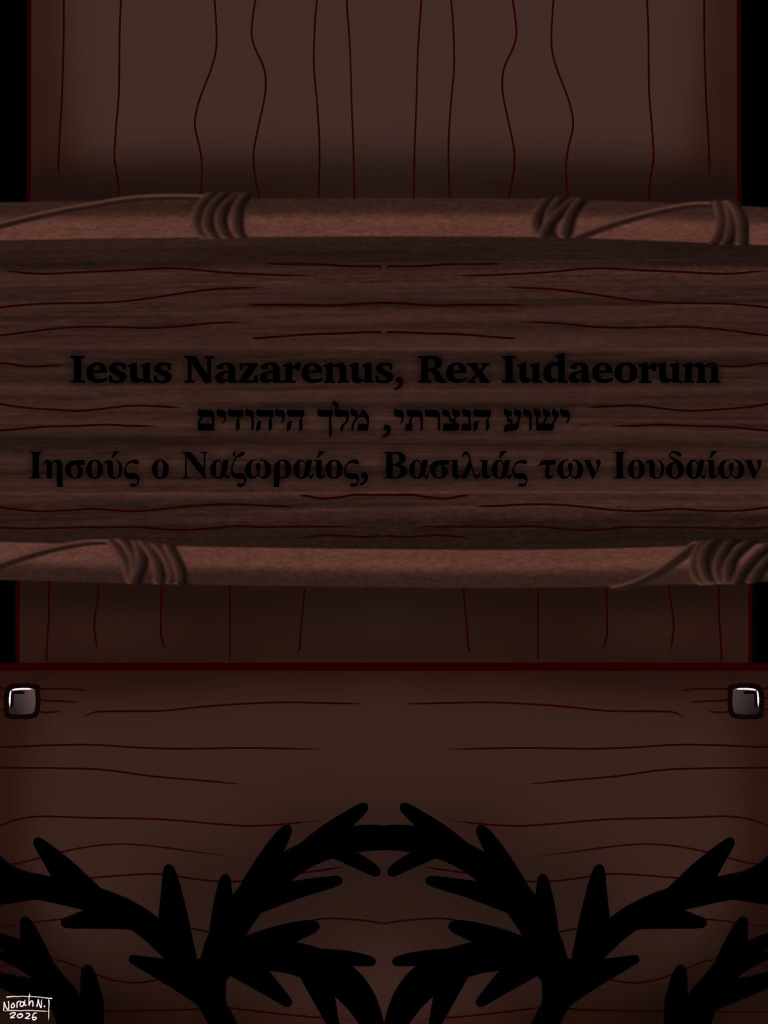
Art by Norah Nettleton.
BIBLETELLING
Below is the Narrative Lectionary passage for the coming week. It is followed by Bruce’s notes on the text which aim at a general understanding of the text and some notes on the structures and techniques used by the Biblical storytellers.
The soldiers took Jesus prisoner. Carrying his cross by himself, he went out to a place called Skull Place (in Aramaic, Golgotha). That’s where they crucified him—and two others with him, one on each side and Jesus in the middle. Pilate had a public notice written and posted on the cross. It read “Jesus the Nazarene, the king of the Jews.” Many of the Jews read this sign, for the place where Jesus was crucified was near the city and it was written in Aramaic, Latin, and Greek. Therefore, the Jewish chief priests complained to Pilate, “Don’t write, ‘The king of the Jews’ but ‘This man said, “I am the king of the Jews.”’”
Pilate answered, “What I’ve written, I’ve written.”1
John 19:16b-22 [CEB]
When the soldiers crucified Jesus, they took his clothes and his sandals, and divided them into four shares, one for each soldier. His shirt was seamless, woven as one piece from the top to the bottom. They said to each other, “Let’s not tear it. Let’s cast lots to see who will get it.” This was to fulfill the scripture,
They divided my clothes among themselves,
and they cast lots for my clothing.2That’s what the soldiers did.3
Jesus’ mother and his mother’s sister, Mary the wife of Cleopas, and Mary Magdalene stood near the cross.4 When Jesus saw his mother and the disciple whom he loved standing nearby, he said to his mother, “Woman5, here is your son.” Then he said to the disciple, “Here is your mother.” And from that time on, this disciple took her into his home.6
After this, knowing that everything was already completed7, in order to fulfill the scripture8, Jesus said, “I am thirsty.” A jar full of sour wine was nearby, so the soldiers soaked a sponge in it, placed it on a hyssop branch, and held it up to his lips. When he had received the sour wine, Jesus said, “It is completed.” Bowing his head, he gave up his life.9
John 19:23-30 [CEB]
It was the Preparation Day and the Jewish leaders didn’t want the bodies to remain on the cross on the Sabbath, especially since that Sabbath was an important day. So they asked Pilate to have the legs of those crucified broken and the bodies taken down.10 Therefore, the soldiers came and broke the legs of the two men who were crucified with Jesus. When they came to Jesus, they saw that he was already dead so they didn’t break his legs. However, one of the soldiers pierced his side with a spear, and immediately blood and water came out11. The one who saw this has testified, and his testimony is true. He knows that he speaks the truth, and he has testified so that you also can believe.12 These things happened to fulfill the scripture, They won’t break any of his bones.13 And another scripture says, They will look at him whom they have pierced.14
After this Joseph of Arimathea asked Pilate if he could take away the body of Jesus. Joseph was a disciple of Jesus, but a secret one because he feared the Jewish authorities. Pilate gave him permission, so he came and took the body away. Nicodemus, the one who at first had come to Jesus at night, was there too.15 He brought a mixture of myrrh and aloe, nearly seventy-five pounds in all. Following Jewish burial customs, they took Jesus’ body and wrapped it, with the spices, in linen cloths. There was a garden in the place where Jesus was crucified, and in the garden was a new tomb in which no one had ever been laid.16 Because it was the Jewish Preparation Day and the tomb was nearby, they laid Jesus in it.
John 19:31-42 [CEB]
THREE STORIES
The following three stories pair well with the Narrative Lectionary passage for the coming week. They are followed by Danny’s sermontelling footnotes which explore the stories’ theological connection to the passage as well as insights into craft and performance. Our advice is to read the story first before digging into the footnotes.
THE CRUCIFIXION
Jesus, my gentle Jesus,17
Walking in the dark of the Garden —
The Garden of Gethsemane,
Saying to the three disciples:
Sorrow is in my soul —
Even unto death;
Tarry ye here a little while,
And watch with me.18
Jesus, my burdened Jesus,
Praying in the dark of the Garden —
The Garden of Gethsemane.
Saying: Father,
Oh, Father,
This bitter cup,
This bitter cup,
Let it pass from me.
Jesus, my sorrowing Jesus,
The sweat like drops of blood upon his brow,
Talking with his Father,
While the three disciples slept,
Saying: Father,
Oh, Father,
Not as I will,
Not as I will,
But let thy will be done.
Oh, look at black-hearted Judas —
Sneaking through the dark of the Garden —
Leading his crucifying mob,
Oh, God!
Strike him down!
Why don't you strike him down,
Before he plants his traitor's kiss
Upon my Jesus' cheek?
And they take my blameless Jesus,
And they drag him to the Governor,
To the mighty Roman Governor.
Great Pilate seated in his hall, —
Great Pilate on his judgment seat,
Said: In this man I find no fault.
I find no fault in him.
And Pilate washed his hands.
But they cried out, saying:
Crucify him! —
Crucify him! —
Crucify him! —
His blood be on our heads,
And they beat my loving Jesus,
They spit on my precious Jesus;
They dressed him up in a purple robe,
They put a crown of thorns upon his head,
And they pressed it down —
Oh, they pressed it down —
And they mocked my sweet King Jesus.
Up Golgotha's rugged road
I see my Jesus go.
I see him sink beneath the load,
I see my drooping Jesus sink.
And then they laid hold on Simon,
Black Simon, yes, black Simon;
They put the cross on Simon,
And Simon bore the cross.
On Calvary, on Calvary,
They crucified my Jesus.
They nailed him to the cruel tree,
And the hammer!19
The hammer!
The hammer!
Rang through Jerusalem's streets.
The hammer!
The hammer!
The hammer!
Rang through jerusalem's streets.
Jesus, my lamb-like Jesus,
Shivering as the nails go through his hands;
Jesus, my lamb-like Jesus,
Shivering as the nails go through his feet.
Jesus, my darling Jesus,
Groaning as the Roman spear plunged in his side;
Jesus, my darling Jesus,
Groaning as the blood came spurting from his wound.
Oh, look how they done my Jesus.20
Mary,
Weeping Mary,
Sees her poor little Jesus on the cross.
Mary,
Weeping Mary,
Sees her sweet, baby Jesus on the cruel cross,
Hanging between two thieves.
And Jesus, my lonesome Jesus,
Called out once more to his Father,
Saying:
My God,
My God,
Why hast thou forsaken me?
And he drooped his head and died.
And the veil of the temple was split in two,
The midday sun refused to shine,
The thunder rumbled and the lightning wrote
An unknown language in the sky.
What a day! Lord, what a day!
When my blessed Jesus died.
Oh, I tremble, yes, I tremble,
It causes me to tremble, tremble,
When I think how Jesus died;
Died on the steeps of Calvary,
How Jesus died for sinners,
Sinners like you and me.21
~ from GOD’S TROMBONES by James Weldon Johnson
THE BLIND CENTURION
However, one of the soldiers pierced his side with a spear, and immediately blood and water came out. The one who saw this has testified, and his testimony is true. He knows that he speaks the truth, and he has testified so that you also can believe.
John 19:34-35
So who was it that saw the soldier pierce Jesus’ side with a spear and who now testifies to these things that we may believe? Most will probably say, ‘John.’ Some of the more savvy might say, ‘the author of John’ or ‘the beloved disciple.’ I don’t think anyone here will say, ‘St. Longinus.’
But that’s exactly how most Christians would have answered the question for thousands of years.
Let me explain. Ancient Christians noticed the same thing we notice about this passage: this emphatic assertion that '“The one who saw this has testified, and his testimony is true!” seems to come out of nowhere. Especially, since the part about Jesus being dead is probably the most believable part of the whole story! Why shouldn’t we believe Jesus was dead after hanging on the cross. Why would we need eye witness testimony?22
Ancient and medieval readers found in these verses a hint of another story. According to them, ‘the one who saw these things’ was the centurion himself who now testifies about these things because he is a believer. In fact, according to this tradition, he is the same centurion who in Matthew says, “Surely this man was the son of God.”23 He had to be. What Roman could say that about Jesus but one who was recently converted?
But what happened that caused this soldier to convert? What was it about piercing Jesus’ side and seeing the blood and water separate that caused such a change in his heart? The answer seemed to be the fact that he saw it at all. And so it was that the legend on Longinus, the blind centurion, was born…24
According to the story, Longinus25 was a grizzled veteran by the time he was assigned to lead his cohort in Jerusalem. He had seen his share of bloodshed on the frontiers of the empire as he fought in Ceasar’s wars of expansion. He carried the burden with him of the terrible things he had to do. Of innocent lives killed. But now, he was far away from all that. He was in that sometimes rowdy but mostly peaceful area of the empire that the Romans called ‘Palestine.’
Longinus’ day to day duties mostly included policing the population. Breaking up fights, catching thieves, barking orders— Mostly though, standing with a sword next to important people and looking menacing. Occasionally he had to help crucify thieves, rapists, and murderers. But it was nothing like being on the battlefield. And frankly, being in charge meant he usually didn’t have to do the dirty work.
Which was good, because Longinus’ eyesight had greatly deteriorated. He had cataracts in his eyes. Everyone knew he had poor eyesight. His soldiers teased him lightly and called him ‘old man’ even though he was just in his late 40s. But no one really knew the extent of his blindness. In recent years, he had only been able to see light and shadow. The world looked to him like dark figures coming in and out of a gray fog.26 He could only see colors when something was held up to his face. Even then, they were muted and hard to distinguish.
Longinus got around this by being imperious. Demanding his underlings read things out loud to him. Commanding them to do things he was incapable of doing. Tackling the occasional shadow that was lunging at him and asking questions later. It seemed to be working, but Longinus knew it wouldn’t for much longer. The dimming lamps in his eyes would eventually go out, plunging him into a world of darkness. Then he would have to retire.
The day Jesus was crucified started out pretty ordinary. It was the week of the big Jewish festival and, sure enough, that meant a group of thieves, rapists, and murderers to execute. These festivals caused the population to quadruple for a week which led to crime. Also, it seemed like every year at least one religious nut got a posse together and tried to storm the praetorium. Crucifixions had become as much a part of the festival as anything else.
Longinus didn’t enjoy crucifixions. Many of his younger officers who had never seen real war seemed to relish it. Even get off on it. They enjoyed flogging their helpless victims, inventing ways to humiliate them, pushing them when they dragged their feet carrying their crossbar through town. They liked to mock them as they wiggled and struggled for breath, once nailed to the post. Longinus had long since met his quota for cruelty and bloodshed. But he did console himself with the fact that keeping peace was much more orderly than waging war. There were no innocent women and children being led out to Golgotha. Just people who knew the rules and broke them anyway. He took no delight in crucifixion but he didn’t lose sleep over it either.
At least he hadn’t yet. As the centurion in charge of the day’s executions, he stood next to Pilate as he’d released a prisoner back into the crowd. Pilate did this every year at the festival. It was actually very shrewd. Nothing tightens a tyrants grip on power like showing a little amnesty. Pilate usually tried to release the most sympathetic character available. You know, a father who stole bread to feed his seven kids. A kid who was clearly just in love but accused of rape by a pregnant girl’s family. Some kindly old woman who had let the zealots meet in her home. Pilate would release this feel good story to the crowd and everyone would go home feeling a little better about Roman rule.
This year Pilate had his mark picked out.
There was this Galilean rabbi that the people just seemed to adore. Days earlier, they were cheering in the streets and calling him their king. Longinus had been there, holding his sword and looking menacing, as he watched the black outlines of palms wave back and forth in the ashen sky.27
The temple priests had brought Jesus earlier that morning, demanding he be executed for high treason. They accused him of threatening violent insurrection and telling people not to pay their taxes. Longinus was in the room when Pilate cross examined the would-be conqueror. Jesus’ shadow stood still as a black-marble statue as Pilate circled him asking questions. It quickly became clear the man was harmless. Yes, his message was a little loopy but so was much of this weird ‘one god’ talk. Jesus talked mostly about love and a ‘spiritual kingdom.’ He’d sounded like a philosopher who had drunk a little too much hemlock— if you know what I mean —not a revolutionary.
So Pilate decided Jesus would be a perfect festival pardon. Someone the crowd loved who wouldn’t come back and bite him in the butt later.
Now Pilate always let the crowd choose but the game was rigged. He called it bad choice, good choice. He liked to put the harmless person he had decided to pardon next to the most dangerous and repugnant criminal he could find. This year it was the Galilean love rabbi or this murderous thug named Barabbas. And man, he looked the part. Even Longinus could tell the difference. He saw pilate standing between two shadows. One frail and sympathetic (it helped that he had just been roughed up by Longinus’ soldiers) and the other, hulking and beastly.
Pilate called out to the crowd, “Who shall I release to you? Your beloved king or the murderer they call Barabbas?”
To everyone’s great astonishment, the crowd chose Barabbas. It wasn’t even close. If it had been close, Pilate would have picked out the voice he wanted to hear, but the crowd roared and chanted: ‘Give us Barabbas.’ Longinus’ could see Pilate’s silhouette looking back at him. He was guessing, with a ‘what do I do, now?’ expression. Longinus sighed. “He’ll be right back here soon enough.”
Barabbas walking into that crowd looked to Longinus like the shadow of a man in a trance walking into an inky black ocean then disappearing.
And so it was that Jesus from Nazareth was led out with the murderers, rapists, and thieves to be crucified. Jesus didn’t look dangerous to Longinus but he wasn’t able to look in his eyes or anything. And if the people wanted to crucify him that much, well, maybe he had done something to deserve his punishment.
What was clear though was that this man was not built for what he was about to endure. He struggled with the weight of his crossbeam and fell several times, lagging behind. Longinus’ soldiers encouraged him by picking him up and kicking him. Barking at him to keep moving. But when it became clear to Longinus that this Jesus just wouldn’t be able to keep up, it looked into the crowd and saw the outline of a man with a good frame and impressed him into service. One of the benefits of being a Roman soldier was that you could make anyone carry anything for any reason. The rule was up to a mile. That included crossbeams.
Longinus kept the rear as Jesus and the stranger walked together ahead of him. Then they got to Golgotha. There on a small hill were the posts they used for crucifixion. It was designed to be visible to people walking in and out of the city. You know— send a message.
First, at Longinus’ command, the soldiers laid the criminals down and drove nails into their wrists to attach them to their cross bars. Once they were hanging, they would be thrashing and you didn’t want to risk someone breaking loose. Then the crossbars were affixed to the posts. Contrary to popular belief, they didn’t nail the feet. There was no reason to. The whole point of crucifixion wasn’t the nails, it was the struggle for breath. There was a little peg that jutted out on the beam that was just enough for the criminal to lift themselves up for a second and breathe before collapsing again. This wasn’t mercy. It prolonged the execution. The victims would push themselves up and down on their crosses for hours, sometimes days, until finally giving up.
Longinus had learned in war that the way a man died revealed much about him. Did he beg and plead? Did he curse and spit? Did he pray to the gods? Did he leave a last minute message for his loved ones? Did he accept his fate silently and stoically? What was true in war was also true in peace. The cross revealed the truth of a man.
Jesus didn’t last but a couple of hours. He suffered like the rest. He struggled for breath. He panted of thirst. He prayed, offered consolation for his family. The usual. Except. One thing he said, was completely different.
Longinus knew just enough Aramaic to break up fights, bark orders, and offer directions. He would never forget that grim shadow hanging on his cross in the dull light of the afternoon, lifting up his head and speaking. “Abba…” That meant ‘Father.’ ‘Release them.’ He knew that one. He’d used that one many times. ‘Don’t know.’ He’d shrugged and said that more times than he could count. Anytime he was over his head in an Aramaic conversation. ‘Don’t know.’
"Father,
Release them.
They don't know."
‘Who was his father?’ He thought, ‘and what don’t we know?’
Suddenly he knew. These Jews had one god and sometimes they called him ‘Father.’ ‘This man is innocent’ Longinus thought, ‘He’s praying to his god to forgive us.’28
He’d never heard that one before. Jesus, in his last moments, wasn’t concerned for himself or those he loved. He was concerned for those who had hung him there. He’d asked his Father to forgive the people who had condemned him to death. The people who had whipped him and spat on him and humiliated him. The people who had pinned him down and nailed him to the beam from which he now hung. He’d asked his god to forgive him, Longinus. But Longinus knew that even if the gods heard this strange Jew’s prayers. He had more innocent blood on his hands than could ever be forgiven.
The thought, once it lodged itself in Longinus’ mind, would not get unlodged. The screaming of innocent women and children. The pleas of peasants on their knees just before he swung his sword to carry out the order. The guilty he forgot. The enemy too. But the innocent were always with him. It was why he’d never married. Because deep down he knew he didn’t deserve the familial bliss he’d robbed so many of. It was why he’d signed up to go to dusty old Palestine. It was why he didn’t sleep more than 4 hours a night and, that, only after a skin of wine. The innocent stayed with him. Their faces. Their voices. They never left. And this Jesus was about to be one of them.
"Father,
Release them.
They don't know."
But now Longinus did know. And it would make no difference.
Finally, Pilate ordered the thing to be over. Sometimes you would leave the bodies on the crosses for days to pecked at, sun burnt and writhing in agony. Then to decay. Unless you were going to need the posts again. Or, as in the case of today, you had some kind of religious festival where the sight would be too antagonizing to the population. Then, what you did was take a club and break the legs of the victims. This ended their struggle for breath and they died in short order. Then after a while you would take the bodies down, and if no one claimed them (few rarely did) they would be dumped in a mass grave.
When it came time to break the legs, Jesus was already dead. Longinus was following behind his fellow shadows dutifully as they broke the legs of each man. When they got to Jesus. He was hanging limp, having long given up his struggle. Now Longinus had learned a trick in war. He always poked a dead body in the side with a spear. If they were truly dead (and not lying limp to try and get away), they would involuntarily jolt. So Longinus said to the shadow ahead of him, “Move over.”
Then he took his spear and jabbed Jesus’ side with it. He saw only the shadow hanging motionless. He did not see the spurt of blood and water. If he did, he would have moved out of the way. But he didn’t and it splattered his face.
“Gods!” he shouted. The soldier next to him laughed.
Longinus was horrified. It was a nightmare. His face was literally soaked in innocent blood. Suddenly he realized his world of gray and shadow had become pitch black.
“It’s in my eyes!”
He dropped his spear, threw off his helmet, and began to wipe his eyes. He wiped and wiped. Then finally he opened his eyes and they began to let some light back in. It was back. His familiar world of gray fog and hazy shadows. He looked up at the limp body hanging from the cross. He was about to give the order for it to be taken down, but as he stared at the shadow of the innocent man, it began to flicker.
Suddenly Longinus saw skin and hair and blood. He saw thorns. Crystal sharp thorns. He saw a kind face with eyes closed. A serene— smile? —upon his lips. He was hanging upon a rough hewn cross. Longinus could see the texture of the grain. He could see the bright light of midday. The green grass at his feet. The soldiers beside him. Their actual faces. Their beautiful, ugly faces.
“Are you okay?” said the young soldier next to him. The words rang in his ears. Not the soldier’s. These words:
"Father,
Release them.
They don't know."
What man could say that? What man could mean that? What man’s blood, flowing from his lifeless body, could heal. Longinus dropped to his knees. What have we done? He thought. What have we done?
Longinus looked up at the young soldier with tears in his eyes.
“This man… this was the son of God.”
On his knees, the Centurion prayed. “Father, release me. Not on my account. I don’t deserve it. I knew they were innocent. I knew they were all innocent. But I’m so tired of carrying them with me. Release me on account of your son. He is the innocent one! Release me for his sake.”29
And so, according to tradition, Longinus was the first Roman convert. Later, he found the Apostles and they taught him all about the things Jesus said and did, why he died, and how he had been raised from the dead. And Longinus believed. He became a missionary who would go on to be martyred for sharing the Gospel. In fact, from that day on he was no longer a soldier. How could one who had been forgiven go back to killing the innocent? He turned in his helmet, his standard, his shield. Everything he had worked so hard for. It was rubbish to him now. But, according to tradition, he kept the spear. The holy object that had pierced the side of Jesus. He kept it to remind him the moment his guilt came into contact with his Savior’s innocence.
And that is the story of St. Longinus.
Now I know that we Protestants aren’t much for saint stories. I get that. Their tales are often fantastical and their veneration feels a little too pagan for our sensibilities. But whether or not we believe the story of St. Longinus, we can affirm that the cross is a place where miracles happen. Where eyes are opened. Lives are changed. Forgiveness is found. Why else would we be so excited this morning to sing:
At the cross, at the cross,
where I first saw the light,
And the burden of my heart rolled away!
It was there, by faith, I received my sight,
and now I am happy all the day.
~ My retelling of an old Christian legend
GOOD FRIDAY IN HEAVEN
How do they observe Good Friday in Heaven?30 Surely that is something we can only dream of. I imagine that the saints and angels and all the rest of us gather round and hear the stories from the people who were there. Can you imagine? To hear Peter’s account of his denying Jesus in the courtyard? To hear Simon of Cyrene tell of carrying the cross with him through the streets of Jerusalem? Or to hear Mary tell of how she wept and held his lifeless body at Golgotha? I should like to spend Good Friday with them someday and hear their stories, wouldn’t you? So imagine with me…
One Good Friday in Heaven, the saints and angels and all the rest of us gathered around as a man stood up and testified.
He said: “Jesus took my place. See, I am Barabbas. I was condemned to die for terrible crimes. I killed a man. Not in self defense. Not in a fit of rage! I planned it as part of an uprising against the government. When the soldiers descended on us, my hands were already stained with innocent blood. I was guilty as charged. Ready to be executed. Then the crowd was offered a choice between me and Jesus. Who will you save? Me, Barabbas, the murderer! Or Jesus, the innocent one. And they chose me. Jesus died in my place! He bore my cross up the hill to calvary. He died and I was released! And now I stand before you weeping— a freed and forgiven man! —because he suffered and died for me.”
The saints and angels and all the rest of us cheered and praised God for the man’s testimony. Because we knew that we too in our own way had experienced Jesus suffering for us.
Then a second man stood up and testified.
He said: “Jesus did not take my place. I was there that day too. I was an innocent man.31 I had been in the wrong place days earlier during Barabbas’ uprising. He had been about to kill me when the soldiers descended. But I was swept away with all the insurrectionists. I was spit on. I was whipped. I was slapped and humiliated. And I never deserved it. No, on that Friday, I was a victim being led to the slaughter, crossbeam on my shoulder. But Jesus was by my side. Every pain I experienced, he experienced too. Side by side, we received our nails. Side by side, we were raised up, naked, as objects of shame. And in those last hours as people, even the other prisoners, hurled insults at him, I didn’t. I couldn’t. Because he understood what I was going through. I defended him. I said, ‘this man is innocent!’ I don’t know how I knew that, but I did. It was his kindness and his warmth when he went through the ordeal with me. When I felt myself slipping away, I looked at him and said, ‘Remember me.’ And he did. And that is why I am here, today.32 Because in my shame, in my agony, and even in my death he never forgot me. And now I stand before you praising— a redeemed man! —because he suffered and died with me.”
Then the saints and angels and all the rest of us silently thanked God for the man’s testimony. Because we knew that we too in our own way had experienced Jesus suffering with us.
~ Original Parable
From the Archives: THE TRANSFUSION
One evening, two parents entered their son’s room to talk to him about donating blood. The boy was eight years old and his twin sister had one of those medical conditions that require regular blood transfusions. She was desperately in need of one and the doctors knew her twin brother’s blood would be the best match. The parents were reluctant to have the boy donate his blood because they were afraid the experience would be too traumatic…
SERMONTELLING NOTES:
This statement coming from Pilate thematically closes his part of the narrative. Throughout Jesus’ trial before Pilate, Pilate asks questions about Jesus’ kingship. Climactically, he parades Jesus before his accusers dressed as a king and calls Jesus “the king of the Jews” and “your king.” Now, backed into a corner politically, he hands Jesus over to be crucified, but on the sign intended to list the crimes Jesus has committed, Pilate lists simply “King of the Jews.” Whether Pilate intends this as mockery his personal understanding of Jesus’ identity is unclear.
In the same vein, Jesus is placed at the center of the crucifixion tableau, akin to the position of a king on his dais, with chief advisors to the left and right of the throne. Common thieves take these places of royal honor
The scripture being “fulfilled” in this incident is quoted from Psalm 22:18. Jesus’ early followers quickly came to read Psalm 22 in connection to Jesus’ death on the cross. The imagery of that Psalm is in uncanny alignment with the torment of a death on the cross. Other gospel writers allude to Psalm 22 by quoting its opening line “My God, my God, why have you forsaken me?” as the words of Jesus on the cross.
Psalm 22 claims by its superscription to be “of David.” It begins by David calling out to God in a very dark hour, but ends with a cannonade of praise for God’s deliverance from death. The Psalmist declares that generations to come will proclaim God’s praise because of this deliverance saying “He has done it!”
“So that is what the soldiers did” is grammatically redundant. The storyteller has already told us that they have done it. The emphasis here is on the word “so” which the CEB omits for better flow in English.) The soldiers may believe they are making the decision to cast lots in order to preserve a nice garment from being torn. In fact, they are doing so to fulfill a scripture of which they are probably completely unaware.
Yeah. That’s a lot of Marys. On first reading it even looks like two of them might be sisters. Mary is the Greek rendering of the Hebrew name “Miriam.” In the Torah, Miriam was sister to Moses. She engineered his rescue at the Nile as a child and accompanied him as a coleader as he led the people of Israel through the wilderness.
“Woman” is not a rude form of address in this culture. In fact, the only other time Jesus addresses Mary in John’s gospel he also addresses her as “woman.” This was at the extreme other end of the gospel story (John 2:4) in the story in which Jesus turned water into wine. In that moment, his word to her was “My time has not yet come.” Here, at the cross, his words will be bittersweet. His time has now arrived.
Perhaps we are meant to carry other details of the wedding story here as we meditate on the crucifixion scene. Wine is often called “the blood of the grape.” In the Eucharist, we receive wine as Jesus’ own blood.” John’s crucifixion story includes a mingling of blood and water as a “final sign” of his death which echoes his “first sign that he performed at Cana in Galilee.”
Jesus consigns his mother into John’s care. Jesus has brothers who would presumably be expected to take responsibility for their mother. Psalm 69, which Jesus is about to enact, is much like Psalm 22 in that it records a moment in the life of David where he despairs of his life and God rescues him. In that Psalm, David mourns the fact that his earthly brothers have abandoned him. Perhaps Jesus seeks to place his mother in the care of somebody who can understand the necessity and meaning of his death.
If this “beloved disciple” is also the “other disciple” who followed Jesus into his trial before Annas (John 18:15), perhaps Jesus believed that John could shelter her from the inevitable persecutions to come.
The shape of this introductory phrase is reminiscent of (John 13:3). In each case, Jesus’ knowledge of where he stood in the unfolding story gives him strength to further humble himself.
The particular scripture in mind here is probably Psalm 69:21. While not quite as “on the nose” as Psalm 22 in capturing the anguish Jesus is suffering on the cross, Psalm 69 evokes the depth of rejection, persecution, and derision which Jesus faces in this moment. As with Psalm 22, this mockery is momentary, to be replaced by celebration of God’s ultimate deliverance.
The Greek word teleos features prevalently in this passage. The word means “completed.” Jesus knows “…that everything was already completed…” The drink of vinegar was “…in order to complete the scripture…” When Jesus received the drink, he declares “It is completed”
This thought seems to echo the final line of Psalm 22: “He has done it!”
Death by crucifixion was not usually the result of blood loss. Being suspended with arms overhead caused painful difficulty in exhaling and eventual asphyxiation. A small ledge provided below the feet allowed the victim to push up and gasp for air, actually prolonging the painful process of dying. A faster, more merciful (but equally painful) death could be provided by breaking the victim’s legs so that they could no longer catch their breath and would asphyxiate more quickly.
Medically, the mixed fluid coming from Jesus was probably a pleural effusion, indicating that the heart had already stopped beating. Roman soldiers didn’t know much about medicine, but they knew dead all too well, and this man was dead.
The storyteller steps in to underline his role as an eyewitness to this event. This interruption signals that there is something particularly significant about the flow of blood and water that the hearers are supposed to stop and contemplate.
One of the mysteries of John’s gospel is that he does not narrate Jesus’ baptism or the Lord’s Supper in the upper room. He does, however provide a robust theology of the sacraments within his telling of the story. For example, Jesus tells Nicodemus in John 3:5 “Unless someone is born of water and the Spirit, it’s not possible to enter God’s kingdom.” In John 6:53, he tells the crowd “Unless you eat the flesh of the Son of Man and drink his blood, you have no life in you.” The associated themes of “living water” and Jesus as the “Passover Lamb” permeate the gospel.
One way to understand this event upon which the storyteller now shines a bright spotlight is to see these sacramental themes come to their climax at the cross in a flood of blood and water.
Both Exodus 12:46 and Number 9:12 give regulations for the Passover sacrifice stipulating that the bones of the lamb were not to be broken. They narrator does not quote either of these verses verbatim, but catches their essence and applies them to Jesus as the Passover lamb.
The storyteller has Zechariah 12:10 in mind here, which presents an interpretive challenge. In Zechariah, it is unclear precisely who has been pierced. However, the result of Jerusalem looking on the one they have pierced is a deep grief compared to the losing of a firstborn son. This grief leads to repentance and the restoration of Israel.
What is important to us is how the storyteller uses this verse. We find Jesus as a figure to be looked upon and as God’s son both in play in John 3:14-16. Jesus compares himself to the snake Moses lifted up in the wilderness. This serpent was constructed of bronze, and in the story, those who looked upon it were spared from the death caused by a plague of snakes in the wilderness.
Jesus is also said to be God’s only son, whom he offers up on our behalf. By contrast, God spared all of the firstborn sons of Israel in the Passover.
Two prominent citizens step forward to recover Jesus’ body. Most victims of crucifixion were not granted the dignity of a private burial. The bodies were generally consigned to mass graves. Nicodemus is named here by the storyteller just in case we missed the subtle reference to John chapter 3 triggered by his quotation of Zechariah 12. ; )
Only the author of John mentions that Jesus was buried in a garden, and he manages to tell us this twice in the span of one sentence. That seems an odd detail to give us about the place where a person is being buried.
Unless…
THE CRUCIFIXION
The following poem is reprinted from GOD’S TROMBONES: SEVEN NEGRO SERMONS IN VERSE by James Weldon Johnson. Johnson was a writer, editor, and civil rights activist during the Harlem Renaissance. In his introduction to the book he writes about how an interest in the black folk tradition had led to a rediscovery and appreciation of many stories, poems, and songs which hailed back to the experience of slavery in the American South. He remarks that a form of black folk tradition that has gone unexamined is the sermon. He shares his experience of hearing common sermons is fixed forms in disparate parts of the country and at different times in his life and argues that these sermons are part of an oral tradition that have been passed down from the days of slave churches right up until his own time in the late 1920s. The book is his attempt to preserve seven of these sermons in a poetic form that will recreate something of their power and their effect on the hearer. We should imagine this sermon on the crucifixion being dramatically rendered from the pulpit in a full congregation. It will come alive for you if you read it aloud.
If you, like me, do not come out of the black preaching tradition, I believe you can share this poem without being disrespectful. Especially, if you introduce it and put it into its proper context. My strong advice is to read it the way you would read any other poetry. Don’t put on an affect or try to imitate a style of preaching that is alien to you. The words and the repetition do most of the work anyway. If you are uncomfortable with it, you could invite another voice to read it or play a video like the one featured further down in these notes.
As Christian pastors, though, I don’t believe we should let fear keep us from exposing our congregations to the full witness of Christian tradition.
I would pound my fist on the pulpit as I say ‘the hammer.’
Or: ‘Look what they did to my Jesus…’
If you want to hear how a distinguished drama troupe performs this sermon, watch this video.
THE BLIND CENTURION
John is probably asserting eye-witness testimony here to underline that Jesus was in fact dead. Scholars today have noted that, at many points, John’s Gospel seems to be shadowboxing with an early form of docetism which may have taught that Jesus didn’t actually die a bodily death because he was, in fact, spirit. This testimony could also be designed to refute notions that Jesus wasn’t actually dead when he was laid in the tomb and his ‘resurrection’ was actually his coming out of some kind of shock induced coma. The point is, by the fourth and fifth centuries, these early controversies would have largely melted away.
The paragraphs above may seem like a long wind up to this story. If I find myself telling it, this would be my ‘way in.’ You may find your own. When I tell a ‘saint story’ to a protestant audience, I like to give it some context as it will likely be unfamiliar.
The name ‘Longinus’ was not a common name in the early centuries of the common era. It seems to be derived from the latin word for lance, ‘lonche.’ Being the soldier who pierced Jesus’ side with a lance, it’s a bit on the nose. It would be like if in English he were named ‘Lancelot.’
This is imagery I will come back to in this story several times. Most of the action in the story has nothing to do with Longinus’ blindness so it is my job as storyteller to keep that fact alive so that when the miraculous event occurs it has impact.
A little on the nose. So sue me!
The Greek word, aphiemi, which is used for ‘forgive’ means ‘to release.’ This has the sense of releasing one from a debt or a prison. It’s a powerful way to think about forgiveness.
This moment is the climax of the story. Longinus finds the redemption he is looking for. Practically speaking, this means all the tension has been broken. Once we hit this moment in a story, the wrap up needs to be as quick as possible while still being satisfying. I will finish up by describing the rest of Longinus’ story in quick broad strokes.
GOOD FRIDAY IN HEAVEN
This parable is a simple contrast parable. A contrast parable is when two different ways of seeing/being are held up next to each other. Think of the parable of the wise and foolish builder in Matthew 7. In that case the contrast is a positive followed by a negative. This parable contrasts two equally valid ways of seeing the crucifixion. Though the first is more common.
The best parables start with an important theological point you want to convey. Then you work on it until you find the best comparison. In this case, I wanted to tell the important truth that Jesus suffers both for us and with us. Often times as preachers, we’re really good at the for us part. We’re good about talking about how Jesus removes the guilt for the things that we have done. What we’re less good at is talking about how Jesus suffers with the victim. The cross speaks also to those who are burdened with the shame of things done for them. If someone feels worthless and unloved in the aftermath of abuse, the message of the cross is hollow if it’s only for the perpetrator. What does the cross say to the innocent who hasn’t been spared? I’ve been looking for a while for a simple way to tell this story. It came to me in a conversation with some friends about the difference between the experience of Barabbas and ‘the good thief.’
The ‘good thief’ traditionally known as Dismas’ story is told in Luke 23:40-43. In this passage, he declares his guilt from the cross claiming that he is getting what he deserves for his deeds. I have omitted this from my parable to draw a more clean contrast between his experience and Barabbas. Conversely, I have plaid up Barabbas’ guilt. In this story, they function as archetypes of two ways of seeing the crucifixion.